Sunday, July 25, 2010

Bathtub science


The kids are in the bathtub; we hear water pouring.

Jordan: Now who felt it?
Aaron: Maybe me.
Jordan: Who felt it on his foot?
Aaron: Maybe me.
Jordan: See, that’s an experiment.  You pour it on both and you see which one feels it.
Aaron: Okay.
Jordan: Okay, so what we’re going to do is put this in the water, press down on it, now Aaron, you put your legs inside my legs.  Aaron do this, do this.  And I’ll do this, okay?  So we’re trying to do an experiment.  We’re going ot pour some right here in between my feet, and who feels it the most.  Actually we’re going to pour it right here, and with this suction cup, and these two legs are supposed to go up.  Now it has a certain vibration.  So it can go in here and over here, or through here, or this way.  Let’s try it.
Aaron: Oh, I feeled it!
Jordan: Now where did you feel it?
Aaron: On my feet.
Jordan: Now we’ll try it over here.  I know exactly where to put it.  Right between these two legs.  There, did you feel it?
Aaron: Yeah.
Jordan: Did I feel it?
Aaron: Yeah.
Jordan: Right, I did.  Now let’s do this, I’ll make a circle with my feet.  I do the pose.  [Pours.] 
Aaron: I feeled it!
Jordan: Did I feel it?
Aaron: Yes.
Jordan: No, this time I did not feel it, actually the water went right through.  Now Aaron, look right here, get right in here.
Aaron: Noooo,
Jordan: But Aaron it’s an experiment.
Aaron: I’m going to be a –
Jordan: It’s not an “I’m going to be a” game, it’s an experiment.  You go right here.

[I stopped transcribing, but it went on for a loooong time.  After the science lesson there was yoga class.]

Yellowstone: Food

There is nothing remarkable about the food at Yellowstone, except that the menus include a lot of bison meat, as they do in Montana.  Bison meat is supposedly healthier than regular beef (lower in fat and cholesterol) and tastes very similar.  The majority of bison in the world are raised for meat; some are pastured, some are raised in feedlots.  There is no sourcing of any of the meat on the menus at Yellowstone, although some of the hamburgers are advertised as “sustainable,” whatever that means.  Some of the seafood is marked as being certified by the Marine Stewardship Council, which I think is meaningful, and some other menu items are marked with a little logo designating them as “including sustainable or organic ingredients,” which I think is not meaningful.  There is an overall effort (on the part of the hospitality company that runs the place) to appear environmentally conscious, which is laudable if it’s real.  “Yellow Is The New Green!” was the slogan.  However, the much-touted recycling bins in the rooms were not useful to me:  recycle what?  Cans and bottles, surely, but paper?  Plastic?  And then there was the bar of soap with the hole in the middle, eliminating that wasteful soap chip.  That was just odd.


Back to the food:  I arrived with the grim expectation of eating nothing but fast food all week.  Fast food offends my body and my soul but I can’t bring a week’s worth of food on the plane, or cart it in from Bozeman, so while a guest of Yellowstone (or, rather, the resort company that runs provides all hospitality services) I was prepared to make do.  The food turned out to be a variety of institutional food, ranging from junk to fairly classy hotel food.  The menus were almost the same at each lodge.  I assume it was all factory food.  I don’t claim to know how one might serve fresh, high-quality food to so many people in such a non-agricultural location, but I long for the day.

When I got home, our garden was bursting with produce and I stood in the yard eating fresh English peas.  Home sweet home!

Yellowstone: Thermal features

[Still trying to catch up... this is old, but I feel like I can't post anything newer until I get this up!]


I can’t stop thinking about what it must have been like to encounter this place by surprise – to be out on a journey and find…. holes in the ground roaring sulfurous steam?  Fountains of boiling poison water blasting a hundred feet in the air?  Gentle (boiling poisonous) springs trickling out of terraced pools sculpted from mineral icicles, colored with algae?  Not to mention the gorgeous mountains and lakes and waterfalls and canyons. The whole thing is superlatively dramatic. 

We started at Mammoth Hot Springs, where the hot water carries dissolved limestone that deposits onto the surface, changing the ground shape by an inch or more per month.  You walk on long boardwalks through the moonscapes of the dry areas.


Then, in the areas with active springs, multicolored “thermophiles” (heat-loving microorganisms) tint the water in strong oranges and yellows.  Their intricate growth combines with the crystal buildup of the limestone to make boggling patterns, like things you might find on another planet.  And in fact they think we might find them on another planet: scientists study these specialized chemical environments for clues about possible extraterrestrial life.  Super weird.


Everywhere you go there are hot springs, geysers, fumeroles (steam holes), and mud pots.  The hot springs are often really beautiful, with twisty tunnel shapes in the clear blue depths, looking like the coolest swimming pool, only it’s hot. 


At mud pots, the sulfuric acid in the water dissolves the rock into gloppy mud, and the gas blurps up through it.  Rather like boiling pudding.  The kids find it hilarious and actually so do I.  [We took movies, but Blogger can't seem to handle them, sorry.]

Geysers can bubble, spray, or just steam ominously.  Fumeroles are just holes in the ground where gas escapes, but somehow they are the spookiest of all; they often make cavernous hooting or roaring or rumbling sounds, and you wonder what the hell is about to come out of there.  Aaron does not like them at all.  He doesn’t like anything that steams, in fact, and has to be carried long distances when we are among geysers.  It helps a lot if he calls them by different, non-scary names:  beysers, gweisers, schmeisers, etc.  (Language is so weirdly powerful.)  Jordan, on the other hand, cannot get enough.  To him they are volcanoes, and wonderful.  He wants more geysers every day.


Friday, July 16, 2010

Yellowstone: Wildlife

When not at the inn, we do long “game drives” punctuated by stops to see entertaining thermal features or other big sights.  Here we are in our rented minivan:


Here is a much better picture of us at a picnic on a lunch stop:


Dale is a completely awesome guide and driver, somehow able to both smoothly transport us from place to place and also spot wildlife - either far away and thus small, or up close and thus almost already behind us.  He really made it great.  Dad kept a list of all the wild animals we spotted on the trip:

American Bison
Bighorn Sheep
Black-tailed Deer
Chipmunk
Elk
Grizzly Bear
Ground Squirrel
Mule Deer
Pine Squirrel
Pronghorn Antelope
Yellow-bellied Marmot

American Crow
American Robin
American White Pelican
Bald Eagle
Black-billed Magpie
Canada Goose
Clark's Nutcracker
Common Raven
Green-bellied Swallow
Mallard
Mountain Bluebird
Osprey
Red-tailed hawk
Sandhill Crane
Trumpeter Swan
Western Gull

I am especially enamored of the buffalo.  Not only do you really not see them anywhere else (in the wild), but they are so… big, and unique, and powerful-looking, and implacable.  Yesterday we saw a couple sitting right by the road, uninterested in the gawking tourists.  We watched them from quite close up for quite some time.  In the binoculars, they are downright monstrous.  On what I think of as “buffalo day” we saw a herd of hundreds of them spread out over a giant rolling valley, with lots of calves.  They were pretty far off, though, and not much in a photograph, which just doesn’t give the sense of scale.  Years ago, a friend of mine was surrounded by a moving herd at night, in his car, and that sounded pretty major.  I would kind of like that.  Unprotected by the car, though, I find them pretty scary at close range.  There are signs all over that overconfident tourists are regularly gored by buffalo and to keep your distance.  Yikes. 

Later we were in a classic Yellowstone buffalo traffic jam.  They just stand there in the road, probably enjoying messing with us. 


I wonder what the deal is with the buffalo, because the ones we have seen have not been avoiding the heat at all; in fact they sit right out in the sun, in their impossibly shaggy wool, and not even on the cool grass but in dirt sand-pit type of things that maybe they made themselves, maybe for dust baths.  These are called “bison wallows” and, according to Wikipedia (which I can only use now that I have internet again), may be used wet or dry, for reasons that scientists only guess at.  The fields are dotted with them.


The fields are also dotted with buffalo poop, which Jordan and Aaron find thrilling.  Here they are seeking it out.


They also love their new binoculars (presents from Grandpa), even though we think they have not actually figured out how to use them.  Aaron especially loves to describe the wonders he’s seeing, as he holds the binoculars onto his nose.  His other favorite activity is hunting (see below).  We keep explaining that there is no hunting in the national park.


Yellowstone: Lodging


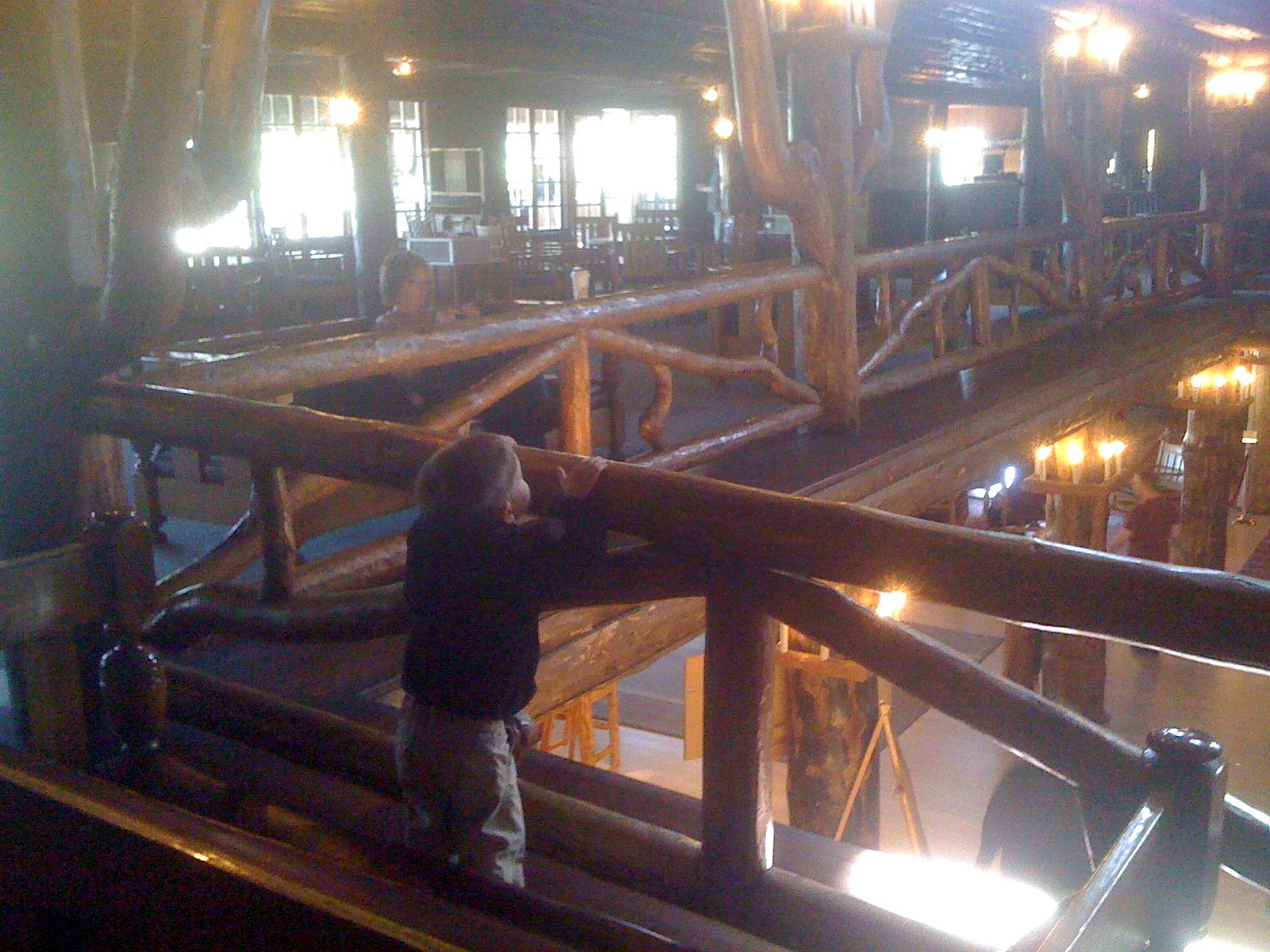
We are staying at the Old Faithful Inn, a multistory log cabin kind of place whose rough-hewn beams are worn smooth by generations.  Beautiful and elegantly rustic.  It’s supposed to look like it grew here, and it does:


Those beams are all the natural forms that were cut from trees in the area.  The inner lobby is the whole height of the building.  The common areas on the balconies surrounding the lobby are really wonderful.  Big old leather-and-wood chairs and couches overlooking the central area, and people actually fill those spaces right up, because the rooms are too dim to hang out in or even read in.  There’s also a giant deck, from which you can watch Old Faithful.  Or you can walk over to the geyser viewing area and watch from closer up. You can tell when it’s about to erupt by the accumulation of tourists.  Our room is charming and rustic with bare wood walls and dim electric lights built to imitate candles.  Early visitors apparently expected electricity, as well as running water and central heat. 


I love the sink in the room.  However, they are not original… they were added in the 1980s, apparently.  Before that people only had bathrooms down the hall.  Shared toilets and showers are still there, and are actually very nice.  


We toured three of the other lodges in the park and each has its own totally unique style.  The Roosevelt Lodge is a hunting-lodge type of place with a “great room” in the main building and the lodging in tiny little cabins.  The Mammoth Hot Springs Hotel is practically Grecian, with its pale buttery colors and classical clean lines.  And then there is my secret favorite, the Canyon Lodge, an “ugly strip-mall” according to my dad’s guidebook but to me, a marvelous example of modernist architecture.  Maybe it’s so out it’s in.  Look at the awesome clock in the lounge. 


Yellowstone: We went!


I have no idea when was the last time I was without internet so long and one of the serious difficulties was being unable to blog during our first family visit to a national park!  Dad got the bug from seeing the Ken Burns series, “America’s Best Idea,” and he thought it would be much more fun to go with us, meaning particularly our children.  We gladly signed up, as did Jes, Deena, Sue, and Bill, and it was a great week.  We stayed at a terrific place, saw tons of wildlife, gaped at geysers, and got along great.  The children were inestimably patient with all the driving and walking and restaurants, and really enjoyed themselves, very much fulfilling Grandpa’s vision of the whole thing.  In what follows I’ll blog on what I think are the important topics: lodging, wildlife, thermal features, and food.  (Food is always an important topic with me.)

[I’m still struggling with the pictures, so I’m going to post the text now and keep adding in the pictures as I can.]

Monday, July 5, 2010

Professor in training

Jordan gets a report card from religious school.  He got "yes" marks in all categories, which include a dozen or so things like "I can retell the Bible stories we learned in class" and "I'm a good listener."  His teacher wrote the following comment at the bottom:

"Each child brings a special gift to our class.  Jordan is our "professor in training."  He has a great sense of humor but when delivering information to the group it is done with great seriousness and intent."

Thank goodness professors can still have a sense of humor.