Sunday, June 5, 2011

Bryce Canyon

This place is not for me.


I don't mean that I don't like it.  I mean that it does not seem to me to be human-oriented.


You stand at the very top of the big canyon looking in, and the thing is full of these giant, weird formations called hoodoos.  Pillars, spires, sculptures, windows, arches, walls?  The native american mythology is that they used to be people, and I can see that.  But the scale is all wrong.  It looks like you are gazing down into some kind of city full of chess pieces and dinosaurs and flying buttresses.  But really it looks like nothing you would have a name for.


For example, here is an arch.  The bridge leads to nothing; the path under the arch goes from nowhere to nowhere, too steep and gravelly to walk on.  You can use words that make this formation seem like something that is part of your human world, but you're just telling a story.


I think part of the reason I feel this way is that my home is the Pacific Northwest, where the wilderness feels magically lush and accessible.  Okay, the idea that any wild space is created for my comfort is a major illusion, but for pete's sake what am I supposed to think, when the shady woods are full of bubbly streams and berries?  It's so easy to believe in a provident Nature there.  Here, I felt like I was very much on my own, survivalwise.  I actually enjoyed feeling this way.  It felt like something a person ought to keep in mind, not just for survival, but in order to enjoy an appropriate humility about one's place in the world.  It's really a lot bigger than you, and shaped by forces that are way beyond your sphere.


In addition to everything being totally outsized and fairly spooky-looking, it is a just plain harsh environment.  The sandstone doesn't invite much to grow in it.  The canyon rim is quite high (8000-9000 feet), so even just being there felt like hard work, much less walking.  It's also very dry, so my nose was bleeding, and it's super hot during the day and briskly cold at night.  We were cranky and got headaches.  I remembered the feeling from Nepal.


We enjoyed the striking strangeness of it for a couple of days.  We did less hiking and more overlook-gazing than in Zion; though Dale and Deena did go down into the canyon for one long hike and enjoyed it a lot, the rest of us didn't want to do the down-and-up part.  We did some wonderful stargazing on both nights; on the second night, we kept the boys up late and taught them some constellations.  They're actually harder to spot when the sky is so very sparkly... my city-trained eyes could hardly pick out the familiar patterns.

Coral Pink Sand Dunes

(Catching up on vacation posts.)  On the way from Zion to Bryce, there are Coral Pink Sand Dunes.  Our kids love nothing more than sand so I thought it was worth a stop.  It was awesome.  The sand was velvety soft and yes, a lovely salmon pink color.  Bare feet were a must.  The top inch of the sand was warm, and below that it was cool.  It was so fine that we watched a beetle leave fancy tracks in it.


I learned a little about the geology of sand dunes.  For dunes to occur, you need (1) a source of sand; (2) lots of wind; and (3) particular geological formations so that the wind slows down rather suddenly, dropping its load of particles.  In this neighborhood, the abundant Navajo sandstone provides the sand.  I don't know why it's windy (why is anywhere windy?) but what wind there is is funneled up this giant bowling-alley-shaped region, concentrating and eventually slowing the fast-moving air so that the sand all falls right here.  Continual winds keep the sands shifting and prevent much vegetation from taking hold.


In the background of the above photo, some teenagers with toboggans are trudging up the biggest dune, hoping for a fun slide down.  It didn't work: the sand is not slidey enough.  This is a shame, because it's devilishly tiring to walk around here.

We did make it to the top of a smaller hill for a photo.

Tuesday, May 31, 2011

English muffin

I just remembered this other bit of cultural conversation from yesterday, when we were having a snack.

J: Why are English muffins called English muffins?
R: I think because they have muffins like this in England.
J: But this is not really a muffin.
R: I agree.  A muffin is more like a cupcake without frosting.  But in England I guess this is a muffin.  [musing briefly]  Except I am pretty sure that this, in England, is not called a muffin at all.
J: What is it called?
R: I think it is called a crumpet.
J: Crumpet!  Like a trumpet!
A: Too too too!
R: Rhymes with trumpet.  And they put the butter on the top, instead of cutting it in half like we do.  But I think they still toast it.
J: That is funny.  Crumpet.  Why don't they call it an English muffin?
R: Well they're already in England so they don't have to call it English if it's already English.
D: We don't call this "American asparagus."  We already know it's American.
R: And what we call French fries are called something else if you're in France.  Not French fries, because they know that already.
J: What are they called?
R: Frites.  Which means fries.
J: Just fries?
D: Pommes frites, right?  Fried potatoes.
J: That makes sense.
R: And you know what, in England they call French fries even something else than that, not French fries or frites.
J: What?
R: Chips!
J: Chips?!
A: Potato chips?
R: Right, but they are not what we call chips!  We call it chips when it's potato chips, the thin crispy kind, but they call it chips when it's french fries.
J: [laughing his head off]  That is so funny!
R: You know how sometimes you order fish and chips at a restaurant and you get fish and fries?  That's because it's an English food and they call fries, chips.
J [looking very surprised]: That's why!  I didn't know that!  I was thinking I would get chips!
R: You did get chips!  But English chips!
J [dissolving in laughter]

Prime Minister Moses

(I still owe a post about Bryce, but I wanted to get this down.)  Getting ready for school today:

J: How many continents are there?
R: Seven.
J: Why are there only seven?
R: How many do you think there should be?
J: Like twenty.
R: Why?
J: So that more people could be president.
R: Oh.  Actually a president is the leader of a country, not a continent.  There are lots and lots of countries, so there are lots and lots of leaders.
J: What?  What's the difference between a country and a continent?
[I paused the conversation to go dry my hair, which gave me a minute to collect my thoughts.  When we got out the door:]
R: Okay, Jordan, I thought about your question some more, and here's what I have to say.  A continent is a big piece of land surrounded all around by oceans.
J: Right.  I know that.
R: A country is when a bunch of people agree that they want to have all the same rules and laws and be on the same team.
J:  OHH.  Okay.
R: Mostly, so far, when people have decided to have the same rules and laws and be on the same team, it has not been all the people on a whole continent.  Just some.  And the others on the same continent make a different team, which is a different country.
J: I get it.
R: There is one country that I know of that is a whole continent.  Australia.
J: They all decided, the whole continent of people, to make one country.
R [sweeping a couple centuries of colonialism and so on under the rug]: Right.
J: So they have one president.
R: They have one leader.  I don't think they call their leader the president though.  I think they call their leader the prime minister.
J [laughing]: Prime minister.  Like prime rib.  Grandpa ate prime rib at that restaurant.
R: That's funny.  Do you know what prime means?
J: No.
R: It means number one.
J: Oh.  So Grandpa had the number one rib and the leader is the number one minister.  What's a minister?
R [bogging down again]: Um.  A leader.
J: Okay.  [walking a minute]  So Moses was a minister.
R: Um.
J: And in fact he was a prince too.  So I think he was the prime minister.  Of the Jewish people.

Very logical.  Fortunately we arrived at school at that point, so I could not dig myself into a yet deeper hole.  It turns out I am all wrong about Australia, anyway; they do not have their own prime minister, but rather a Governor-General, who normally does what the Prime Minister (of Britain) says.

The real point ought to have been that political distinctions may be different from geographic ones, but who knows what Jordan will find most compelling.

Wednesday, May 25, 2011

Zion Canyon

Here's what people really come to Zion for.


The way the giant walls and towers of rock loom over you on all sides is really hard to convey with photographs.  Everywhere you go, in town or in the park, these giant red and brown and orange and white striated craggy cliffs are in your peripheral vision.  They're staggering.  I feel like they are watching me.


The whole thing used to be dunes, part of an enormous ocean of sand the largest the planet has ever known, larger than the present Sahara.  The sand was pressed into sandstone under its own weight.  This region's sandstone is special in that it is infused with iron, which gives the rust-red colors, and calcium, which makes white streaks.  Today the Virgin River continually reshapes the landscape, carving and re-carving its way through the path of least resistance, mostly during the violent flood season.  


The rock is porous.  In a surprising number of places, water soaks into the rock up high and drips out far below, creating "weeping rocks" that feed hanging gardens of ferns and flowers.  Not what you expect to see in the desert.  There are also plenty of waterfalls.  This one fell over a large sheltering overhang.


Here are several tourists gazing upon a Weeping Rock.  Aaron did not wish to be wept upon.


After learning that there were supposedly no buffalo in Zion, Aaron said, "But I see a buffalo head right there," and pointed out this astonishing rock formation.  How about that?


Our usual routine is to get up earlyish, load up at the breakfast buffet, hop on the shuttle, and take easy hikes all morning.  We range from age 3 to 70 so we don't try anything too ambitious... our pace is about one mile per hour, and it's easy for some among us to get too hot or too tired.  We find our way back to town for a late lunch, rest in the afternoon, and do another walk or activity in the evening.


People do crazy stuff here... one of the most popular hikes, the Narrows, involves being actually in the river multiple times - wading back and forth and even swimming across, unpredictably, because the river changes the route all the time.  That "hike" is closed right now because the high volume of water in the river threatens to sweep away unsuspecting tourists.  I didn't want to go anyway.  Plenty of people do the Angels Landing hike, so called because the original explorers were sure that only angels would have a good way to get there:  the last stretch has you traversing a sheer fin of sandstone with a 1400-foot drop on each side, though hey, there are now anchored support chains on some sections of the trail.  No thank you.  The really certifiable ones, according to the rangers, are the rock climbers who scale those vertical sandstone walls.  They are referred to as wall-nuts.

Zion National Park

We are in Zion on a family vacation for a week, our second annual national park visit (last year was Yellowstone).  We elected to go now, in May, rather than wait until school is out for the kids, because in July the heat is really limiting.  This week's weather has been marvelous; about 80 during the day, cooler in the mornings and evenings, one brief fresh drizzle of rain.  (In Seattle, meanwhile, it's cold and raining every day.  Sorry friends!)

We are staying in Springdale, Utah, a little town at the entrance of the park.  It's very pleasant.  It's actually in Zion Canyon, so it is surrounded by much the same stunning scenery as you get within the park; almost all the businesses are small independent shops, restaurants, and inns; and the transportation to the park is very easy.  I wasn't expecting much from our Best Western, but every room has picture windows with views of the towering red cliffs, and there is a lovely back porch for evenings, as well as a pool and a big lawn for impromptu soccer (very important to Jordan and Aaron).

To get to the park, the easiest and most common thing to do is to take the free, propane-powered shuttle. The "town shuttle" comes by every 5-10 minutes, stops at several locations in town, and drops you off at the visitor center in 10 minutes.  From there, you enter the park on foot, then hop on the "Canyon Shuttle" (also free and frequent) to ride as far as you like up the Zion Canyon.  There are eight different stops to deliver you to various sights and trailheads.  You get off wherever you like, and then when you would like to go somewhere else (either further up the canyon or back home), you get on the next shuttle.  We haven't set foot in the car since we arrived here.  Private vehicles are not allowed past a certain point in the park, and with a system this easy and convenient, there's really no temptation.


The shuttle system has been in place since 2000 and it seems like a wonderful improvement over driving yourself.  Dale was here as a teenager and has vivid memories of stressful searches for nonexistent parking.  Rangers tell us that there used to be 4000 cars in the park every day competing for 450 parking places.  Often people were forced to just drive through rather than hike anywhere, because they just couldn't find anywhere to put the car.  With the new system, not only is it much quieter, easier to enjoy for a longer time, and less polluted, there is more visible wildlife.  


Okay, bit of a joke there.  But in fact wildlife is not a major feature of Zion.  There are mule deer and lizards.  There are peregrine falcons and California condors; these are exciting from an ecological perspective (peregrines were critically endangered but have recovered, condors are still in trouble but are part of a successful recovery program), but we haven't seen any.  Dale, spotter extraordinare, saw a gray fox, but did not manage to photograph it.

Regarding flora, there are many many cottonwoods blowing their fluff all over the place, which the boys find thrilling when it piles up on the ground.  There are also beautiful yellow columbines, pink cactus flowers, and "moon lilies" (first picture below), also known as sacred datura, a poisonous/hallucinogenic plant.  The second flower below is a yucca.


What you really come here for is the geological scenery.  Next post.

Friday, May 20, 2011

Spanish

Living among Spanish speakers for even a few days has been consciousness-raising for me. Having grown up in San Francisco, I always had Spanish around, but my friends didn’t speak it (my neighborhood had mostly Cantonese and Russian). I was mostly hearing Spanish on the bus. In the class I taught here, everyone spoke at least a little English, but some only a little, and I thought it was more important that they learn the course material than practice their English so I encouraged them to speak Spanish when they were collaborating among themselves. Thus, for three days, I was surrounded by Spanish as the professional language of scholars I came to know and respect. It’s a very different sensation from hearing it on the bus.

For someone who never had any Spanish instruction more formal than Sesame Street, I do pretty darned well. I can read signs fairly reliably (my good knowledge of French helps) and I can even read a paragraph of accessible text if I have a minute. For example, in my hotel there was a card on the bed with advice for a good sleep: “Practice exercise with regularity.  In the night avoid stimulants such as coffee, nicotine, and drinking much liquids.  Listen to music channel 41 on your television while you prepare to sleep. Lie down, place two pillows under your feet, and take six deep breaths, in and out.” I can speak some too; my accent is very good, I am told, and if I am prepared, I can do things like ask the breakfast lady to charge the breakfast to my room (“Desayuno a la habitación, por favor, doce-cero-uno”) and even respond sensibly when she says “Caliente o frio?”  In Starbucks, I ordered in Spanish, and she rattled back a question to me about "crema" so I said si, and "para llevar" to which I also said si.  But I am easily tripped up, because then she seemed to be asking for my number.  Huh?  Oh, right, nombre is “name.”  See?  I am not very good.  And then taking a taxi to the airport, I found myself needing to ask if the university had already paid for the taxi, and if not would he take a credit card.  I was completely stuck.  I didn’t know the word for “paid,” or the past tense, and the “already” seemed very important but I had no clue about that, and come to think of it would this question even make any sense to them conceptually?  I thought Tec had arranged for this taxi, but I wasn’t certain, and paying for a taxi in advance is not normal in the US, and, um, help?  In French, I would have been all over this (“Est-ce que Tec vous avez déjà payé? Si non j’aurais besoin d’un banque, s’il vous plait.”).  But here they had to call down a manager from the hotel to talk to me.  I was embarrassed to be so helpless.  I think it almost makes it worse that I can almost participate in Spanish.  If it were Thai, I wouldn’t even try to go past hello and goodbye and counting to three, and I wouldn’t worry about it.

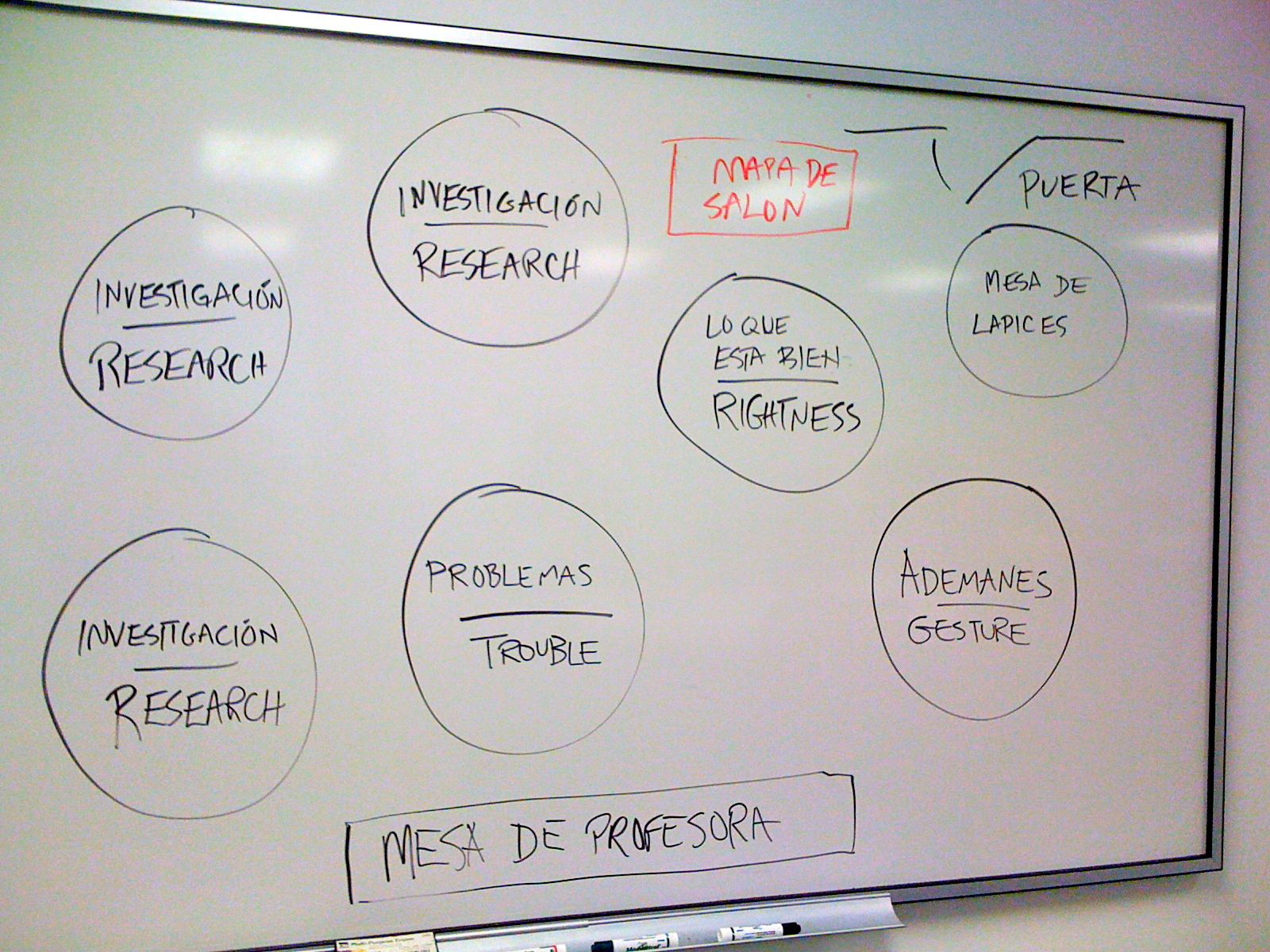
In class, I integrated what Spanish I could, really just for politeness and because I like learning languages.  When we were dealing with technical terms I would have them teach me the Spanish equivalent.  When I wrote an announcement on the board I would get their help writing it in Spanish.  For example, “TARDE: Presentaciónes.  15 min incluyendos preguntas.  Equipo grande – 45 min.”  Here is a map I made of the classroom in which I was assigning different topics to different tables:


As far as understanding people when they spoke, I did well when I had a lot of contextual help.  Watching the people in the class talk together, I often knew the kind of thing they were talking about already (because I knew what question they were answering or what data they were looking at), and by paying attention to their prosody and gestures (which is funny, because that was part of what the class was about) I could track their conversation to a pretty good degree.  I assume I was missing all the interesting details, but it was still fun for me.  Sometimes I could respond to what I thought they were talking about.  Mostly I just listened; if they needed me, they switched to English.  On social occasions (such as dinners out), it’s amazing how much you can figure out partly by knowing what kind of conversation it’s likely to be:  I know they are trying to figure out what time to meet me for dinner, so it’s easy to hear the bits of conversation about what they need to do before leaving campus, how long it will take to get to the restaurant, etc.

Similarly, at the conference I attended on the last day, there was one speaker whose slides provided such good contextualization for his talk that I felt like I was understanding every word he was saying, even though he was talking a mile a minute.  I was briefly very proud of my receptive Spanish.  But then the rest of the meeting was panel discussions (no slides), or talks whose slides were a blur of small technical text going by too fast, and I understood nothing.  I didn’t even get the gist.  I saw that they were presenting a methodology and saying what population was studied, but I had no clue what their methodology or population actually was.  I felt completely awkward.  I want to take this as lesson for talk preparation:  Prepare slides that a Spanish speaker with elementary English could understand.  Surely it is good for the speakers that share my language, too.