Jordan gave a presentation today about his fourth-grade science project. It was great! He did the experiments with Dale and created the presentation with me.
At his presentation today, he was very poised and comfortable, and got a lot of fun comments and questions. "Where did you get those rocks?" "Did you come up with this question yourself?" "Was this a fun science project?" Jordan seemed to enjoy the whole thing very much. I did too.
Thursday, November 7, 2013


Sunday, November 3, 2013
Handwriting exercises
Jordan's handwriting homework involves a lot of fun equipment. First he uses these chopsticks to move beads from place to place, using a careful thumb-and-index-finger grip. He likes to sort them into color groups, or stack them.


The last strengthening exercise is to hold the putty in one hand and push the thumb down into it. This is also very tiring. Dale has learned that his thumb hardly bends that way at all.


I also quiz him on how to make the letters. These letters are made out of just four shapes of "legos": a long straight line, a short straight line, a big curved line, and a small curved line. I say, "How do you make a P?" and his job is to say, "Long straight line, frog jump, small curved line." A B is "long straight line, frog jump, two small curved lines."
This is all fun and takes ten minutes if we're snappy. Aaron does it too, why not?

Then he uses stiff tongs to do the same thing. Pinch to grab the bead, lift up by bending the wrist back, and let go to set the bead down. These tongs are challenging even for me.

Next he is supposed to pull these linked beads apart with his fingertips. This is so difficult as to be a little maddening. Yanking them apart with your closed fist is not allowed.

From there we move on to the fun therapy putty. The first exercise is just to massage it around to warm it up, but only with the fingers, not with the palms or the tabletop. Next he makes it into a snake and pinches it hard between thumb and index finger, sequentially all along its length, three times.

The last strengthening exercise is to hold the putty in one hand and push the thumb down into it. This is also very tiring. Dale has learned that his thumb hardly bends that way at all.

Then he does a little writing. These are the "frog jump letters": you start on the green dot (the lily pad), go straight down (into the pond), then frog jump back up to the green dot for the next move. I notice that when Jordan is doing this exercise, he uses a proper pencil grip. (Then he goes right back to his usual grip when we're done, but that is to be expected.)

This is all fun and takes ten minutes if we're snappy. Aaron does it too, why not?
Monday, October 28, 2013
Hand writing
Jordan and I saw a writing therapist. She conducted new assessments, gave initial observations and opinions, and is now in the process of writing up a report and a treatment plan. I've interviewed many over the phone, so I knew something about what to expect, but I was still amazed by the specifics.
Imagine drawing three overlapping circles, each the size of a quarter. How many hand movements is that? For most of us, three: one for each circle. And all the movement is in the index finger and thumb. For Jordan she stopped counting at 22 separate hand movements. Whoa. The reason is that his pencil grip is almost entirely rigid, so where we move our fingers he moves his wrist, his whole arm (curling and twisting to get into position), his entire BODY (leaving his seat), or rotates the paper itself. She looked at him, looked at me, and said: "What he's doing is exhausting." She asked him to sit straight and keep his paper still while he drew, and he immediately said, "This is so hard! How does anybody do this?!"

This is huge news! This means that Jordan has a significant physical impairment with writing. Every time he sits down to write anything he's like whoever that artist was who lost the use of his hands and just tied the brush on to paint. The basic theory is that the way he writes now is so taxing, it takes all his working memory and physical stamina to do it, leaving hardly any for things like spelling and sentence formation, much less essay organization. Not only can he not do these things in the moment, he has probably not benefited much from the schooling he has gotten in these things, because he was just not able to do them when they were taught. In therapy the goal is for him to learn writing that is fast, easy, and beautiful, and that will free up a wealth of resources.
I am so excited! Because now someone actually understands (some of) what is going on for him! We have now been through years of having no idea what his trouble is, or even if he really has any trouble beyond just being stubborn or spacey or something else. Years of teachers recognizing that he is not succeeding, but beyond that really just shrugging, having no idea how to help him improve. And now this person in one hour has figured out so much. Now I can really see him as having a writing disability -- possibly a temporary one? or maybe there are things he will never do fluently. Either way, as far as I'm concerned he has the writing equivalent of a broken leg. He needs therapy to get better. He has a therapist who knows exactly what is going on and what to do about it. Maybe he will get all the way better and maybe not; maybe (probably!) he has other obstacles too, which we will find out more about as we go forward. But now we understand one of the major impediments that he has been dealing with. It is a something that can get better. We have the resources to make that happen. And while he is getting better, he needs accommodations, because he literally cannot do the things that kids without a broken leg can do.
Imagine drawing three overlapping circles, each the size of a quarter. How many hand movements is that? For most of us, three: one for each circle. And all the movement is in the index finger and thumb. For Jordan she stopped counting at 22 separate hand movements. Whoa. The reason is that his pencil grip is almost entirely rigid, so where we move our fingers he moves his wrist, his whole arm (curling and twisting to get into position), his entire BODY (leaving his seat), or rotates the paper itself. She looked at him, looked at me, and said: "What he's doing is exhausting." She asked him to sit straight and keep his paper still while he drew, and he immediately said, "This is so hard! How does anybody do this?!"
Whenever there are issues with reading and writing it is important to be really sure what is going on with a kid's vision, so she quizzed me about his glasses and his history of possible amblyopia. She said, "Which is his good eye? Oh - never mind. I can tell." It turns out that when he writes, he turns his body and cocks his head to favor his good eye, putting the paper in the center of the good eye's field of view. Thus his depth perception is poor, which impacts writing, since for accurate writing a pencil point has to contact a plane of paper just so. He also lets his glasses slide down his nose and looks over the top of them, in which case he is necessarily using only the good eye.
At home I took some photos and a little movie of him drawing for fun at his desk. You can see the body positioning, the head tilt, the pencil grip that doesn't involve his fingers really at all, and the way he moves his paper around to give his hand access to the different parts of the drawing. On his own, he uses that sketching motion that he is using here, with repeated short hand movements: the motion for those comes from the wrist, not the fingers. In the writing therapist's session, she asked him to just draw solid lines, and he started moving his whole arm and body around.

The first part of the therapy will be a complete overhaul of his pencil grip, which will also overhaul his handwriting. But you don't start this with the pencil grip; that's just impossible and insanely frustrating for the kid (can you imagine being asked to do that yourself? wouldn't work). First his hands need to be strengthened in the ways that will actually enable him to hold a pencil well -- and specific hand weaknesses may be part of why he developed his grip in the first place. That will take some weeks. During that time she will also be working on assessing, and then addressing, all the other components of writing that we need to know more about: his phoneme discrimination, what he knows about how to spell all the different phonemes, and so on. When the new pencil grip starts, it will be used only with her and only with drawing, not letters. Gradually as both the mental ingredients of writing (like spelling) and the physical aspects (like grip) become more confident, they can be brought together. There may be things like special pens and special paper that help him do what he's trying to do. Those will eventually be brought to school, but school is the last place that the changes get enacted. It's the most high-stakes and the least supportive, so the kid only brings their new techniques to school when they totally own them. When they can say, "This is my stuff. This is how I use it." and need no teacher support (in fact they will probably be educating the teacher), then they take it to school. The whole process will probably take 4-5 months.
Saturday, September 7, 2013
Belated birthday blogging
Three months ago the boys had their birthdays and I didn’t
blog about it. Then I didn’t blog about our many other events this summer… our
20th college reunion, boychoir camp, Camp Kesher, and so on. Ouch!
Part of how you know your life is too busy is the lack of time for reflection.
But never mind; let’s start again.
Aaron had a classic birthday party at home, with a dozen
friends and a cake like a Teenage Mutant Ninja Turtle except purple. (My first
experience with fondant. Fun!)

It was a fabulous hot day, so we set them up for water play
and just let it rip.


Play for an hour, cake at the end, what more do you need?


Parents sat in the shade noshing on
grownup treats. Six is an age when parents start to assume a birthday party is
a dropoff situation, and while part of me appreciates not having to entertain
twenty adults in addition to ten kids, another part of me misses the
opportunity to hang out. So we make it very clear that adults are welcome to
stay at the party, with French cheeses and moscato and such, and cultivate our friendships with those who choose to hang out.

Aaron digs his friends too, and then later he digs the Legos they give him for presents.


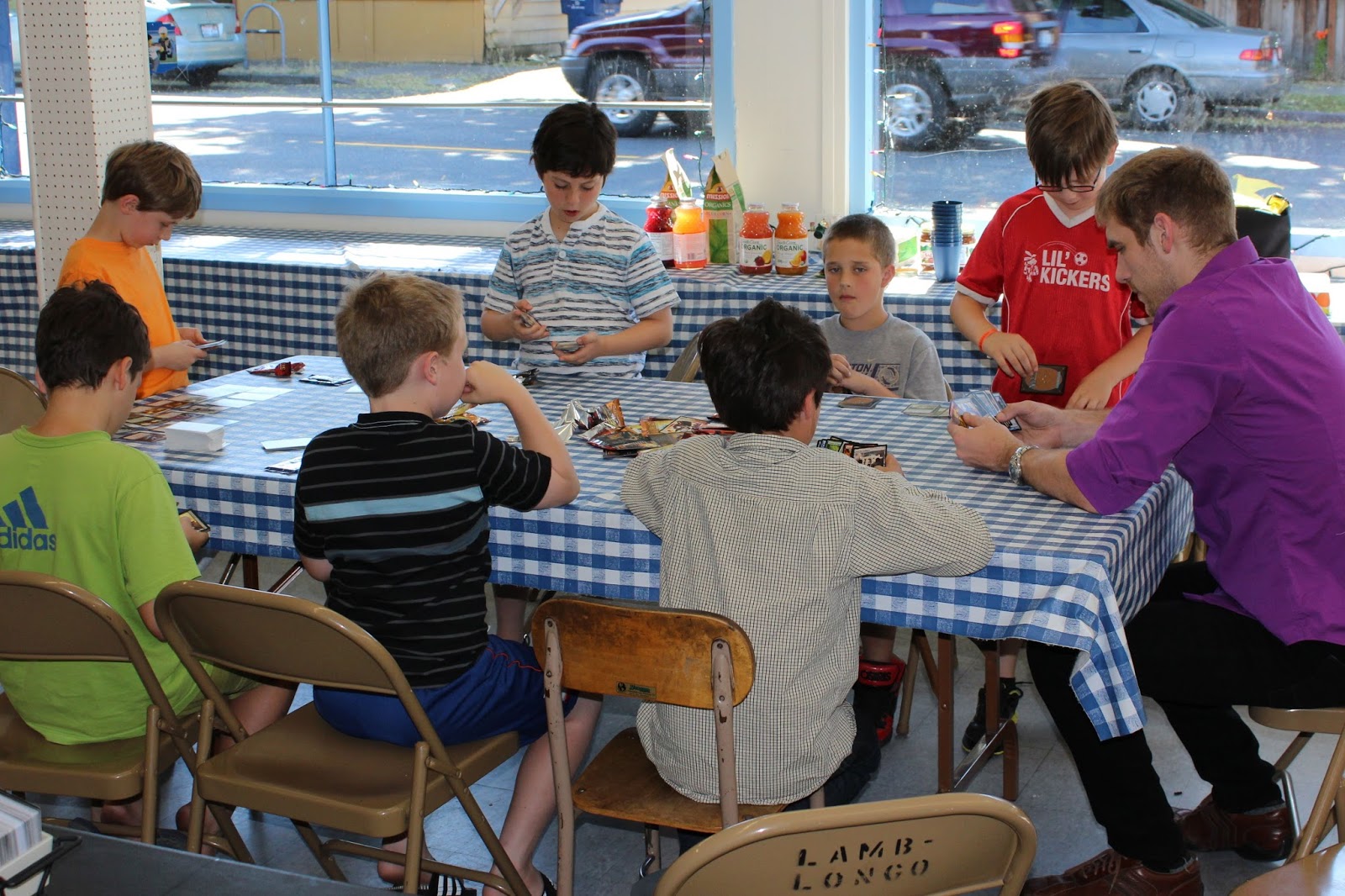
For Jordan, this year was all about Magic: The Gathering. We offered him a true MTG birthday party, held at a toy store that hosts MTG
tournaments and hosted by a young man who knows what’s what. He was totally
thrilled. Here’s the guy:

I had no idea what do to for a cake until a geeky work
friend said, “You just need to put all five mana symbols,” and showed me what
they are and what order they need to go in. Total mystery to me but it came out
great. More fondant.

This is the first time we have had a birthday party outside
the house. The host let me know that this would be a two-hour party and that
the boys would be completely engrossed in playing the whole time. “Fifteen
minutes at the end for cake,” he said, and that’s it. Any additional activities
or snacks or whatever would be ignored. This turned out to be exactly true. The
leader taught everyone how to play, did a “draft circle” to help them build their
decks, and set them into pairs to play. They were obsessed. They wanted no
parent intervention of any kind. They didn't even want chips and salsa. The party favors were the decks they had
built, which was way better than any goody bag. It was the most relaxing
birthday party we’ve ever supervised.


Saturday, June 8, 2013
Lions
Prosper drove us a long, long way to see lions, and we were not disappointed.


We even saw lions mating.

Lions who are mating go off together for a period of about five days, during which they copulate every fifteen to thirty minutes. Who knew? Thus, if you come across them, you can just hang out for another fifteen minutes, and you will see them do it again. But don't blink, because it's quick. During this "honeymoon," as Prosper calls it, they do not eat, and barely drink. They sleep in between sessions. The pair we saw was very tired, especially the male, but he still staggered determinedly after the female whenever she stood up.


Buffalo and hippos
Cape Buffalo
Nobody messes with the cape buffalo. They are huge and powerful. They kill lions.


Their horns are deadly poisonous because of bacteria that flourish on them. Lions who hunt buffalo have learned to attack from behind, aiming to break the back legs and disable the buffalo. If they bring it down, they will begin eating it while it is still alive. Lions teach their cubs how to properly hunt a buffalo. This is so fascinating to me. Do they teach them that the horns are poisonous, or do they only teach them (by modeling) that buffalo must be hunted from the back?
Hippos
Hippo pools are much more crowded, active, and smelly than I realized. Fifty hippos might be stuffed into a pool together, from multiple families, and apparently they get in each other's way, because there is a lot of the hippo equivalent of "Hey, watch it, buddy!"

They continually splash water over themselves with their tails to cool themselves and protect their skin from the sun. But it's not really what I would call water: it's a green frothy sludge of water and hippo poop. They churn it. They prefer to submerge in it, but there's not always room. I was eager to see hippos, and was surprised by how gross they are in real life.

Wildebeest and zebras
Our safari guide, Prosper, was wonderful in many ways: a good driver, a good communicator, funny, kind, and great with the kids. But Prosper was at his best with the animals, both finding them and teaching us about them. Though he could tell you any facts you might want to know, what stuck with me was what he showed us about the animals' personalities and relationships. We saw so much, and without his guidance I would not have understood what I was seeing.
Wildebeest
When I first looked at this scene, I just saw a bunch of wildebeest. The mooing and grunting is very loud.

Prosper showed us that they are arranged in clumps of females guarded by a dominant male. It is rutting season, and the males have a harem to protect. They chase off other males and sometimes clash with them.

But wildebeest have a very short working memory. So once they finish fighting, they stand there looking around blankly, because they've forgotten where their ladies are, or even who they are! Meanwhile some other male has probably taken over, leaving his own harem behind. We had a lot of fun imagining what must go through their heads. "Didn't I see you last night?"

Wildebeest have a great sense of smell, but poor eyesight. If a lion approaches a crowd of migrating wildebeest, they will run away; but the lion knows that if she hides downwind in the tall grass for a couple of minutes, they'll forget she's there, and she can ambush them.


Zebras
Zebras have a less developed sense of smell than wildebeest but excellent eyesight, and are very intelligent. They know the lion is there in the grass, and their response warns the wildebeest. When they stand around, they stand in pairs facing opposite directions to keep a lookout.


In general they were much quieter than the wildebeests. They make a pleasant whickering-whinnying sound.

Zebra foals are fuzzy and their stripes are brown.

Zebras have round bellies like fat ponies because their stomachs are full of worms that aid digestion. (This is an alternative to the four-stomach system that a cow uses.) They only need to drink water once every three or four months. When they do go to a watering hole, the tension is palpable: There might be crocs in the water or lions in the grass, and the zebras know it.

Subscribe to:
Posts (Atom)