The third and fourth weeks that Dad was here, he had radiation treatment every day. And he got more and more weak and tired. He was still able to get around the house on his own, but other than the radiation treatments, he just stayed home. He didn’t read or putter on his laptop. He didn’t talk much. He napped a lot. Sometimes he talked on the phone to friends. He was nauseous and in pain, and his medication options were limited by his inability to swallow; we used dissolvable zofran and concentrated oral morphine. He was cold most of the time, so he sat by the fire and dozed.
His fatigue may have been a side effect of the radiation, or the morphine, or a symptom of malnutrition, or cancer – or all of the above. I stopped feeling comfortable leaving him alone for more than maybe an hour, because he was so weak. I sat with him, and did stuff around the house, and did the work of managing his care. Every day was structured by medical events: the radiation treatment, the IV nutrition, nurses visiting to check up on things, equipment being delivered.
We had a ramp built in front of the house. It seemed obvious that he would need it.
On Friday of the fourth week, he had a drastically bad day, involving not only radiation treatment but also a bone scan and some terrible traffic on I-5. He missed his regular dose of pain meds and became extremely exhausted. When he finally got home, he got into bed, and barely woke up for days. His vital signs were poor (low blood pressure, low blood oxygen, rapid pulse, shallow breathing). The visiting nurse warned us that he might be near the end. At some point when he was awake, I told him what the nurse had said, and he asked me to send an email to his friends to come and visit him. They did, and in the fifth week nine beloved friends came to see him. He rallied, and was able to enjoy his visits with every one of them. It felt like a triumph.
Those who could not visit sent letters and video messages, and we read or played these aloud to him. This was awesome; he was very touched, and we all got to learn more about what he had meant to people. Also during this week, his throat got better: he could swallow his own secretions and no longer suffered from nausea. However, he was still very weak and very disabled, needing a lot of physical assistance to do anything, and a lot of active pain management.
In the sixth week, we hired home health aides to take care of Dad 40 hours a week (during weekdays), to relieve me from much of the physical care that I had been doing. They were wonderful with Dad, and I was so grateful for their help. Dad accepted their care, and tried to get a little stronger by doing things like getting out of bed for a little while each day. His throat continued to be better, and he was even able to drink a little water. He was still receiving IV nutrition around the clock, so the drinking was recreational. But it gave him tremendous pleasure. No one can appreciate a sip of cold ice water like a person who thought they would never have one again.
He remained extremely weak and disabled. Getting out of bed was an achievement. His pain was significantly worse, and we were always chasing it. To some extent this is just how it is with cancer, and with opiates – the pain is a moving target (in his case mostly due to his bones crumbling), and the body adapts to the morphine. Nonetheless it was very stressful and worrisome. The goal is to keep the person both comfortable and awake, and it is an elusive goal. By then he had not been out of the house for weeks (since the end of the radiation treatment), and only got out of bed once or twice a day.
During this period Dad lost his sense of time: he would wake up with no feeling for whether it was day or night, Tuesday or Saturday. To be fair, the life of an invalid is not so different from one day to the next, and he was sleeping off and on without regard to the time of day. But my dad was a man who kept meticulous daily routines and a detailed calendar, and the disorientation was very distressing for him. He always wanted to know what time it was, what day it was, whether he had any appointments that day, who was coming to the house, whether there were any visits from friends in the future. He was always looking for his phone, even though he had lost the dexterity to manipulate it and couldn’t read the screen anymore. Eventually we hung a large-print calendar by his bed and wrote his appointments on it. This was very reassuring to him, and useful for all of us.
During this same period Dad had a lot of very weird dreams that felt very real to him. When he was awake, he mostly understood that they could not have actually happened, but not always. Sometimes he dreamt that he didn’t have cancer, but it always turned out that he did. Once he dreamt that there was a giant bar fight and he was “perched in the rafters with his Group Health gun” (Group Health was his HMO). Many of his dreams were violent or threatening, involving war scenes or international espionage. As the weeks went on, his dreams intruded more on his waking life. Once he wanted me to arrange a meeting with the secretary of state because he thought he was going to be kidnapped by the Russians, who secretly had a cure for esophageal cancer; they were going to take him hostage to demonstrate the cure, and demand payment that would compromise national security. One night when Dale was taking care of him he understood himself to be in a bad restaurant, one with very poor service. “Aren’t there any servers in this place?” he complained. “Can’t we just get a cab and get out of here?” Dale, who was providing the best service possible under the circumstances, said “Man, I really wish we could.”
Friday, April 1, 2016
Dad in January
Dad was diagnosed with metastatic esophageal cancer on December 30, after a months-long period of increasingly severe gastric reflux. He spent two weeks closing up his affairs and saying his goodbyes, then flew up to Seattle to live with us. He was comfortable and mobile and very much himself; it was no problem for him to do things on his own. His main symptom was difficulty eating or drinking.
The first week he was here we visited five oncologists to try and form a treatment plan: two medical oncologists (those are the chemo doctors), two radiation oncologists, and one surgeon. Each of them suggested a different course of treatment. The only unanimity was that surgery would not be any use, because the cancer was too widespread (not only deep into the tissue of his esophagus, but also in his bones, liver, and lymph nodes). We came to realize that for Dad there was really no right answer, or put another way, no wrong answer. The argument for radiation treatment was that it would be short, localized to the major problem area, and not hard on your whole body at once the way chemo is. The argument for chemo was that it treats all the cancer everywhere in the body. The side effects of either were expected to be manageable.
Dad liked the radiation plan better and we would have started the radiation treatment right away, but in that same first week (four days after he arrived here), Dad’s throat closed completely so that he could not swallow anything at all. This was both uncomfortable (he couldn’t swallow his own saliva and needed to retch it up often) and urgently dangerous (he had no way to take in fluids or nutrition). We scheduled a feeding tube insertion for the following week, and brought him to urgent care every other day to get fluids and sometimes glucose. What with the oncologist consultations and the urgent care visits, I did a lot of coloring.
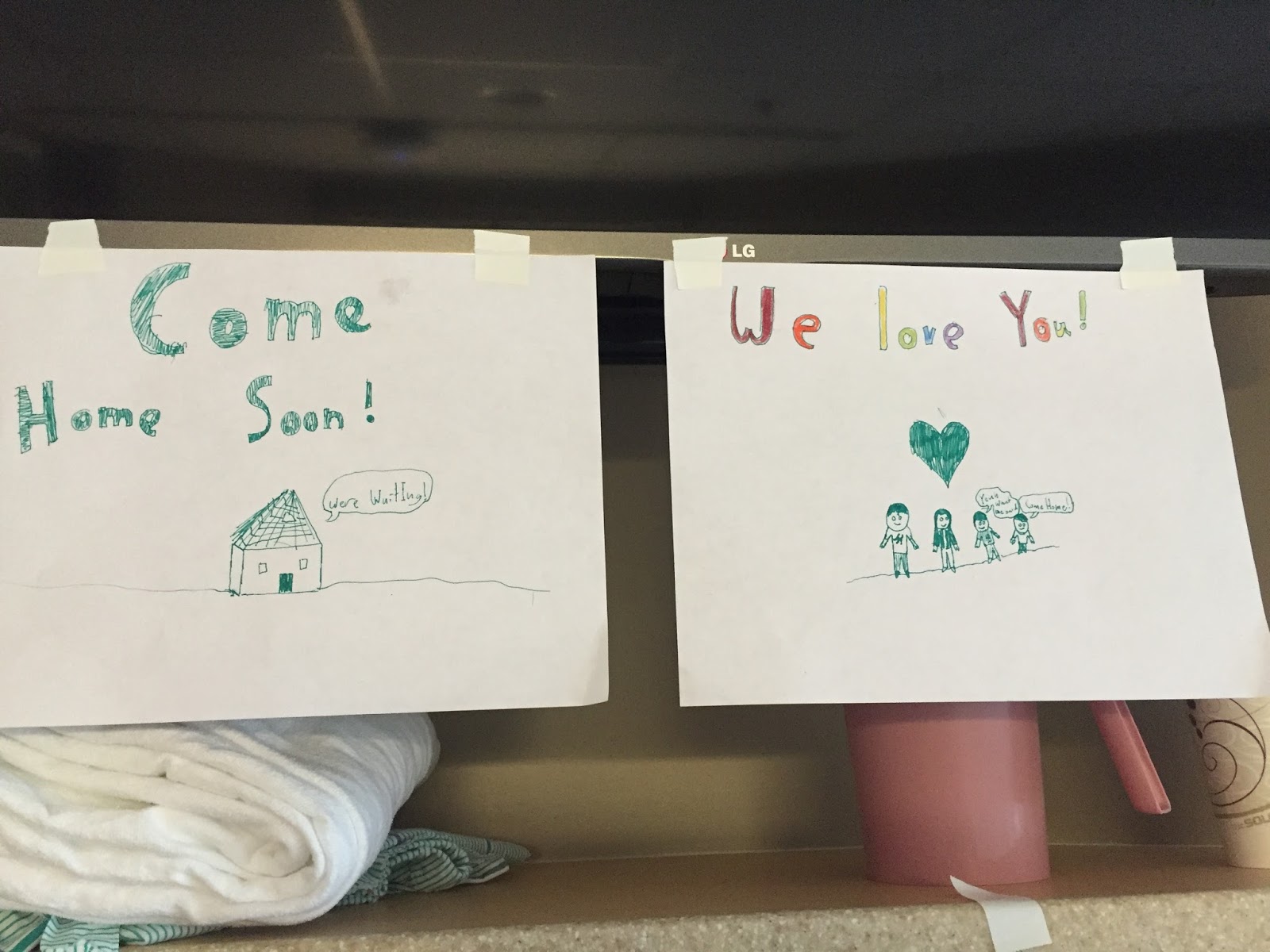
At the beginning of the second week that Dad was here, he was supposed to have the feeding tube inserted, but unfortunately his throat was closed so completely they couldn’t do the procedure (it normally involves snaking a 1-mm endoscope down your throat). They checked him into the hospital, expecting to insert the feeding tube with a different and more invasive surgical procedure. The boys came and made come-home-soon signs, and played chess.
Instead of the anticipated surgery, we wound up choosing for Dad to get IV nutrition at home. At the end of that week he started the IV nutrition, and started having nurses visit him at home almost every day to monitor his various medical needs.
During this period Dad’s primary reaction to his illness was bewilderment. He could hardly believe how sick he was – he had been taking good care of himself and monitoring his health actively for many years, including regular doctor visits and blood tests, and yet there was no warning of this extreme condition. He was also bewildered (and annoyed) by the uncertainty of his situation: no one could tell him how long he had, or what symptoms he was likely to develop, or what exactly a particular treatment would accomplish if anything. But we traipsed together to all of his doctor appointments, and weighed his options, and made the best decisions we could.
Burial
About five years ago Dad arranged to be buried at the veterans’ cemetery nearest us, Tahoma National Cemetery. He appreciated that burial is a veterans’ benefit (he was passionately opposed to burial expenses) and he wanted his gravesite to be convenient for us to visit. (Mom was cremated and her remains are in various places, some in my garden.) He arranged all of this in advance, and gave us all the information and documents we would need to carry out his arrangements, which basically consisted of the name of the cemetery and his discharge papers. It was very simple. I wish I had realized in advance that we would also need mortuary services; I had to figure that out the day he died. But I managed it.
This National Cemetery conducts burials with a brief military service. Pallbearers (some military, some family) conveyed the flag-draped casket from the hearse to the front of a shelter in the cemetery. Patriotic words were said, there was a three-volley fire, and taps was played. There was a beautiful ceremony for folding the flag and presenting it to me.
Then the military people left (with the casket), and the rest of us stayed in the shelter for our family service. About twenty of our friends and family were there with us, which was very meaningful to me. (It was a long way to drive, and in the middle of a weekday!) Alan spoke, and I spoke, and Dale spoke. The boys had intended to speak but were too overwhelmed in the moment, which is fine. We said kaddish. It was beautiful and meaningful.
The one part of the ceremony that was a little rough around the edges was that we wanted to put dirt into the grave, and the National Cemetery does not officially allow this. So we figured out where the gravesite was, and drove over there, and surprised the workers who were doing the actual burial. They didn’t argue with us, and we were able to fulfill our ritual.
We opened our home for three days of condolence calls (shiva), and were extremely touched by having people gather around us like that. Some were friends whose support had been crucial to us all along; some were community members who just wanted to show that they cared; some brought food, cards, and donations to Dad’s preferred charities. It was meaningful and heartening to have people fill our house (and our fridge) in this way. I am grateful for it.
Stephen J. Scherr
[This is the eulogy I read in Seattle at Dad’s burial, and then again at the gatherings in our home.]
Thank you all so much for being here today to honor and remember my father, Stephen Joseph Scherr. He was born in 1940 in Washington DC and grew up in Baltimore. After two years of college and military service, in 1965 he moved to San Francisco, joining his sister Judith and his parents who had moved there a few years before. He married my mother Jean in 1969. They wore paisley pantsuits in a little cottage on Telegraph Hill and I have the pictures to prove it. He was not a hippie, he was a “hippie sympathizer,” in his words (a joke I only got recently). I was born in 1971, and soon after that my parents moved to the Richmond District of San Francisco, where I grew up, and where my father lived until he moved in with us two months ago.
My father graduated from San Francisco Law School in 1972 and spent decades in solo practice as a criminal defense attorney. Most of his clients were ordinary people in difficult circumstances. He also represented politicians, police officers, homeless people, millionaires, priests, and college professors (including one of his own law school professors). His clients included an abused teenager who was taught to abuse younger children, a madam who was sentenced to serve time in a nunnery, a nun who beat her mother to death with a crucifix in an attempted exorcism, and the man who shot the mayor of San Francisco and the first openly gay supervisor (for which the defense is widely misunderstood, so please ask me about it). My grandmother was terribly distressed by my father’s clients, and did not see how he could stomach defending them. But my father believed that for the American judicial system to work, everyone needs the best representation they can receive. He loved representing the underdog, being the underdog, helping to keep the system honest. He had a lifelong commitment against the death penalty, and was glad to be able to say that none of his clients ever was sentenced to death.
Everyone who knew my father knew him to be reliable. This might make him sound boring, and to be honest he was extremely predictable: he wore the same clothes for decades, ate the same foods, wore the same style glasses, drove the same car. More importantly, though, he was reliable in the sense that he kept commitments he made to other people. He generously invited people to rely on him, and then used his knowledge and resources to do what he said he would do. Whether showing up at the agreed time and place, supporting me through college, mentoring a junior colleague, or defending the accused, everyone knew that he would be there and live up to his word. He was solid.
As a father he was witty, kind, and secure in our relationship. He respected me intellectually and admired my decision-making, teaching me to first do my research and then trust my instincts. He saw the best in me, and helped me recognize that even in difficult situations there is much to be grateful for. I see this positive outlook in our children, and hope it will be his legacy to them, along with a strong sense of justice, and a commitment to helping individual people who need it.
Now we are in another difficult situation, and as painful as it is, again there is much to be grateful for. My father lived long enough to have close relationships with Jordan and Aaron. During his illness we were able to bring him to live with us and take the best possible care of him. As a family we have given each other every kind of love and support and emotional safety that a family can give; and we are surrounded by a caring community that holds us up while we are bewildered, tired, and sad. I will miss my dad more than I can say. But I am thankful that his life story ends with dignity and family love.
Thursday, January 7, 2016
Old photos
While I was in San Francisco I tackled a project that Dad has been wishing someone would do for years: the ten shoeboxes of photos under the table in the dining room. His main priority was for someone to throw away the junk and the duplicates, and label the ones worth keeping. Scanning and/or albums could come later, if ever.
I have been avoiding this task for years myself, but this year, I thought, why not. (Even before the diagnosis.) It turned out to be sort of fun and sociable, and it went much faster than I had thought. I sat in the living room, sorting and labeling, and occasionally asking “Who is this lady with the big glasses?” or “What restaurant is this?”
Identifying people in the photos was mostly very easy because almost all of the photos were of the same couple dozen people. Mom, Dad, me, Dale; Dad’s sister, Dad’s mom and her second husband, and Mom and Dad’s two best friends; and Mom’s mom, brothers and sisters-in-law, and their kids. At first, I was careful to label every photo with each person’s full name, but by the time I got to box #3 I decided this was overkill.
Dating the photos was also mostly easy because almost all the photos were from the 1990s. I guess after that, we all went digital. I’m not sure why there weren’t any from earlier; maybe Mom had sorted all those already. I am sure she generated the shoeboxes. Her handwriting was everywhere: she made notes about sending copies of certain photos to certain people, and sometimes (lucky day!) wrote the year or other identifying information on the photo envelope. Dad was never much of a photo-printer in my recollection.
While I worked I thought about how much casual photography has changed in the last twenty years. Back then, we really only took pictures of special occasions, because most of the time no one had a camera. Now we always have a camera. Back then, we had to finish the roll before we sent it in to be developed, so there would be 20 pictures of some family event and then 4 pictures randomly taken around the house. Now there are no “rolls” of “film.” The most exciting anachronism was the slides. We didn’t even have a way to view them. A visiting friend brought over a Kodak Model 1 projector, no fan or carousel or anything, just stick each slide into the slot. When we were done we had let the projector cool off for half an hour before we could touch it.
There were at least two things that made this fun, besides contemplating the march of technology. The first was that I threw a ton of junk away, which was liberating and satisfying:
The second thing that made it fun is that I found some fun treasures. There were pictures of houses I’ve lived in (in college, or when I was teaching at Evergreen) that took my breath away, because I had forgotten what it was like to live there, and hadn’t known there were photos. There were pictures of my parents and their friends in their living room, reminding me of how Pam (now deceased) used to sprawl on the floor and eat potato chips off a napkin, and my mom (also deceased) used to sit in a back corner so she had room to stretch. Am I taking the pictures now that will capture these moments for my kids? Can I even know what those would be?
In another category of treasures, look at this amazing photo of my mother and her brothers. This would have been something like 1943, on her family’s farm in western Massachusetts. The family still owns the same property.
Here is a beautiful mystery photo of some of my ancestors on their wedding day.
And here is a photo that was not previously in our collection, contributed by a friend who came to visit. This is me with her daughter - I'm the one with the bangs.
I have been avoiding this task for years myself, but this year, I thought, why not. (Even before the diagnosis.) It turned out to be sort of fun and sociable, and it went much faster than I had thought. I sat in the living room, sorting and labeling, and occasionally asking “Who is this lady with the big glasses?” or “What restaurant is this?”
Identifying people in the photos was mostly very easy because almost all of the photos were of the same couple dozen people. Mom, Dad, me, Dale; Dad’s sister, Dad’s mom and her second husband, and Mom and Dad’s two best friends; and Mom’s mom, brothers and sisters-in-law, and their kids. At first, I was careful to label every photo with each person’s full name, but by the time I got to box #3 I decided this was overkill.
Dating the photos was also mostly easy because almost all the photos were from the 1990s. I guess after that, we all went digital. I’m not sure why there weren’t any from earlier; maybe Mom had sorted all those already. I am sure she generated the shoeboxes. Her handwriting was everywhere: she made notes about sending copies of certain photos to certain people, and sometimes (lucky day!) wrote the year or other identifying information on the photo envelope. Dad was never much of a photo-printer in my recollection.
While I worked I thought about how much casual photography has changed in the last twenty years. Back then, we really only took pictures of special occasions, because most of the time no one had a camera. Now we always have a camera. Back then, we had to finish the roll before we sent it in to be developed, so there would be 20 pictures of some family event and then 4 pictures randomly taken around the house. Now there are no “rolls” of “film.” The most exciting anachronism was the slides. We didn’t even have a way to view them. A visiting friend brought over a Kodak Model 1 projector, no fan or carousel or anything, just stick each slide into the slot. When we were done we had let the projector cool off for half an hour before we could touch it.
There were at least two things that made this fun, besides contemplating the march of technology. The first was that I threw a ton of junk away, which was liberating and satisfying:
- Negatives. If I want to copy a picture now I will scan it.
- Impersonal photos. Cityscapes, monuments, pretty trees: turns out they mean nothing in an old photo, at least not in our family. None of us cares about a picture of Mount Whatsit, and if we did, we could get a better one in two seconds. Maybe this is why people take selfies now, to personalize otherwise boring or touristy photos.
- Bad photos. Oh my goodness the bad photos. Blurry, crooked, backlit, distant, over- and under-exposed, half full of someone’s elbow. Maybe someone pulled the good photos out of the envelope and put them in an album, leaving only the crap. Or maybe it’s that back then we didn’t get to see the photo until it was developed, so we didn’t realize.
- Duplicates: Remember at something like a wedding you were supposed to send each person a packet of photos appropriate to them, including both the highlights of the event itself, and any cute pictures of the recipient or their loved ones? What a gigantic pain in the neck that must have been. Here’s to progress.
The second thing that made it fun is that I found some fun treasures. There were pictures of houses I’ve lived in (in college, or when I was teaching at Evergreen) that took my breath away, because I had forgotten what it was like to live there, and hadn’t known there were photos. There were pictures of my parents and their friends in their living room, reminding me of how Pam (now deceased) used to sprawl on the floor and eat potato chips off a napkin, and my mom (also deceased) used to sit in a back corner so she had room to stretch. Am I taking the pictures now that will capture these moments for my kids? Can I even know what those would be?
Here is a beautiful mystery photo of some of my ancestors on their wedding day.
And here is a photo that was not previously in our collection, contributed by a friend who came to visit. This is me with her daughter - I'm the one with the bangs.
Grandpa
We went down to San Francisco on December 25, expecting our usual fun winter break with the family. And we did have fun: we saw Star Wars, we went to Alcatraz, we went to the California Academy of Sciences, we watched classic comedies. But the week had a very serious event, which is that my father was diagnosed with esophageal cancer. We did not see this coming. We thought he had a difficult case of acid reflux. Unfortunately, the cancer also involves some lymph nodes, and maybe other places as well.He feels reasonably well at this time, but there are difficult days ahead. We have asked him to come and live with us in Seattle for his upcoming care. His sister lives in SF and is a very able caretaker, but it’s not a one-person job, and it will be much easier for her to commute to Seattle than for me to commute down there (she is retired and lives with one fully capable adult). It has been hard for Dad to imagine leaving his home for an extended time, but he has come around to the idea. We do have a couple of charming grandsons that sweeten the deal.
He plans to come next week. So quite soon, we will be a three-generation household.
Friday, December 25, 2015
Watch

Aaron is a kid who likes to know what time it is, in all senses. He likes to know what’s happening next, and how much time he has before the next transition, so that he can get ready. Jordan is not the same way; Jordan is happy to go along with whatever’s happening next, and doesn’t really need (or care) to know about it in advance. He likes surprises.
Jordan used a watch when he was on tour with the boychoir, because sometimes they were responsible for meeting at a certain place at a certain time. But he does not usually choose to wear his watch in his daily life. Aaron would like to have a watch, and Jordan’s is too big for him, so we agreed to get him his own.
We discussed whether Aaron would want a digital watch or an analog watch. I explained that there are pros and cons of each: If you get an analog watch, you become a master of reading the time, since you practice it a whole lot. If you get a digital watch, you often have extras like a timer and a stopwatch, so if those are useful to you, you might want a digital watch. He chose analog. We found this sweet little timex with a Velcro strap, so it fits a small wrist and is easy to get on and off. He loves it and wears it every day. Apparently he has been keeping tabs on the time in class, pointing out to his teacher when they have five minutes until they need to leave for music etc. I hope she enjoys this.
Subscribe to:
Posts (Atom)