Friday, December 29, 2017

Haircuts

After Jordan's bar mitzvah I decided that I would let him take the lead in his hairstyle. I'll still offer him haircuts, but instead of saying "Haircut time, let's go," I am now saying, "I am making a haircut appointment for Aaron; would you like a haircut also?" The first time I asked the question this way, he said no. He likes his long bangs. That's fine with me. Here he is recently with a chicken.


Amusingly, I had a similar haircut when I was a couple years older than he is now. I found this cute photo. I would guess that I am sixteen here, and that that's my high school in the background, but I'm not sure.


In my opinion, hair is a wonderful canvas for self-expression. That black hair above is not my natural color; I used that to cover up a series of color experiments that started when I was fourteen or so. First I had short hair (what my grandmother lovingly called a "pixie cut"); then I had blunt-cut stripes in the back that alternated brown and blonde; then I bleached it very pale blonde and wore it messy and grew a braided tail, just like Aimee Mann in the Til Tuesday era. (I wish I had pictures of myself with blonde hair, but people just didn't take so many pictures then.) In art class, I realized that my bleached-to-death hair soaked up color like crazy, so I watercolored it in random rainbow hues. Then I dyed it a color that I hoped would be an elegant peacock blue, but turned out to be a ridiculous Smurf blue instead. I couldn't live with that for long, so I covered it up with black. Then I went into a less punk, more hippie phase, and just grew it out naturally for the next several years. Through all of this, my smart parents never said a word. In fact, they paid for all of it without saying a word, which I now think was wonderfully generous of them on both counts.

Aaron, meanwhile, still happily gets terrific haircuts from our regular stylist, Leslie. She is excellent and he looks great.


Aaron cooks

Vacation leisure + new cookbook = Aaron made his first deluxe lunch! Veggie quesadillas, fresh guacamole, deviled eggs, and crudités. Jordan helped a lot and I hardly did anything.


Thanksgiving chickens

We had Thanksgiving over at Kari and Danny's this year, and it was very nice as always. A highlight was the neighbor chickens, which needed care while we were there. These were the friendliest, tamest, most cuddly chickens any of us had ever met. They were so calm that you could walk right up and pet them. The boys learned how to hold them so that they would not flap their wings. Cousin Harry spoke conversationally to the chickens, which seemed to calm them even more.


Aaron was small enough to actually get into the chicken coop, which was useful for changing their water and so on. We wish we could visit these nice chickens all the time!


Tuesday, December 26, 2017

Fagin

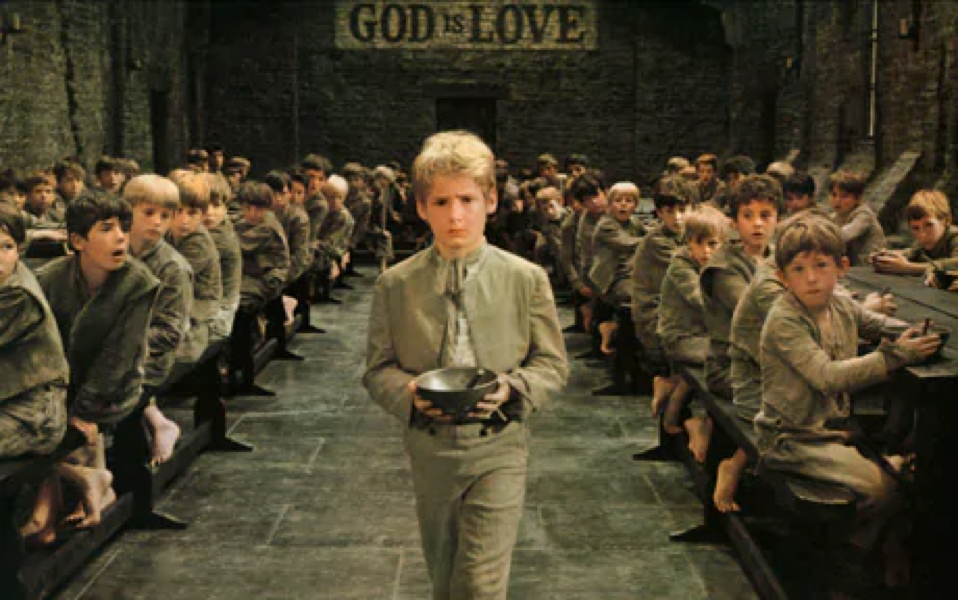
We must have been three-quarters of the way through “Oliver!” when we got to one of Fagin’s dialogues, and I realized that there was vaguely klezmer-ish music playing in the background… and I finally put together that Fagin, the miserly old crook who exploits the pickpocketing boys, is Jewish! I was astonished, as were the kids. In subsequent research, I learned that Fagin is one of (Western) literature’s archetypal Jewish villains; I'm embarrassed to have gotten this far in life and only be learning this now, but what can you do. I also learned that the anti-Semitic content had been greatly toned down for this movie; the 1949 production (!) was protested in postwar Germany and banned in (brand-new) Israel because of the depiction of Fagin, and (thanks to the Anti-Defamation League and the New York Board of Rabbis) wasn’t released in the US until they cut out seven minutes’ worth of big-nosed profile shots. Look at the schnozz they pasted onto Alec Guinness!


Yowza. As I say, the version we saw toned down the Jewish content, but even this version had devil references. For example, here is Ron Moody threatening Oliver with a miniature pitchfork. 


The book apparently was recognized as grotesquely anti-semitic even at the time; a Jewish newspaper asked why "Jews alone should be excluded from the 'sympathizing heart' of this great author and powerful friend of the oppressed.” Dickens said he was just being realistic about the nature of street crime in that era, but he did revise the book to remove some of the offensive content, and wrote a sympathetic Jewish character into a later book. That’s good to know… but I think for family reading time, I will choose a different Dickens book.

Musicals

Over Thanksgiving break, I knew we were going to watch a number of family movies, and I decided we needed a theme. My choice was musicals, which was heartily approved by the others in the household. We started with “Into the Woods,” a terrific Sondheim mashup of various fairy-tales, with hilariously clever lyrics. We particularly enjoyed the badass Red Riding Hood, who is not only not traumatized by being eaten by the wolf, but subsequently makes his fur into a new cloak.


Next up was “Oliver!,” the 1968 movie version of Oliver Twist, which none of us had ever seen. I haven’t even read the book, though I think I saw a TV version as a kid. I was delighted to learn that it is the source of multiple songs that I have always known, such as “Food Glorious Food,” “Consider Yourself,” and “Oom-Pah-Pah.” There were multiple huge dance numbers with dozens or seemingly hundreds of people, and we observed that all the dance was ballet. The children had to have the child labor situation explained to them at some length because they had no idea of the conditions of the Industrial Revolution. We talked about how Dickens was a storyteller with a very strong social justice mission, who stuck up for the poor at a very tough time in history. (Though see other post.) I enjoyed the movie, but thought the character of Oliver was hardly a character at all, which didn’t seem fair for the first child protagonist in an English novel.


The next musical we watched was West Side Story, and wow, what a story. We were all enthralled. I remembered it was good, but it was just SO good. Aaron in particular was snapping his fingers for days. The dancing is fantastic – again, all ballet, and so very far removed from the mincing frippery that one can mistakenly associate with this dance form. I like showing Aaron dance that counters unfortunate gender stereotypes. We also had a good discussion about the fact that most of the actors were in “brownface” (they were white people depicting Puerto Rican people), with the exception of the inimitable Rita Moreno. She apparently recalls that the movie people even put brown makeup on her, because her skin color is lighter than they thought was typical for Puerto Ricans. 


Finally, on a night that Jordan and Dale were out, Aaron and I watched the movie of “Newsies.” Loved it! More discussion of child labor (in New York this time), along with a great talk about how a good writer can speak truth to power. Aaron identifies as a good writer (I agree) and he felt quite inspired about writers helping to solve problems in the world. The dance in this show was less ballet and more acrobatics, and a rip-roaring good time.


Saturday, November 18, 2017

Temple field trip

As part of the eighth grade curriculum at Jordan's religious school, the kids take an all-day field trip to connect with different immigrant and refugee communities in south Seattle. They started the day at East African Community Services, where they had a lesson about the questions you have to be able to answer to pass the US citizenship test. They also heard from a Somali refugee who grew up in a refugee camp in Kenya: he said that in the mornings they would chase the sleepy hyenas, but in the evenings they had to be careful because the then-wide-awake hyenas would chase them. They had lunch at an Ethiopian restaurant and heard from the owner about her journey to the US; at 17, she won a lottery for a US visa, and came here without her family to start a business. 

In the afternoon we visited a Vietnamese Buddhist temple; we were welcomed by a very friendly and informative young man in grey robes, took off our shoes to briefly admire the gorgeous sanctuary, heard a brief biography of the Buddha, and spent most of our time in the amazing gardens above the temple, full of statues and murals. The rabbi had prepared a scavenger hunt to find all the Buddhist symbols and learn what they mean. It was fascinating!


I went along as a chaperone, which was very easy, and gave me the opportunity to see Jordan among his Temple classmates. I observed that the kids sorted themselves into three clear groups: (1) the girls, (2) the boys, and (3) the Billings and SJCS kids, which was a mixed-gender group. This grouping is only a little oversimplified: there was one boy who moved back and forth between groups 2 and 3, and one pair of friends that was mostly on their own. But it was easy to observe. In this photo, they are bunched together but still basically in these three groups.


I didn't pay much attention to the group of girls, but I observed the boys' group, and it was fascinating to me. They had a very different style than Jordan and his friends. They presented as more sportsy, more consciously stylish in their clothes and hairstyles, and a little rougher in terms of their language and demeanor. They were perfectly well-behaved - all the kids were extremely pleasant all day - but  they seemed a little socially precocious to me, as if they were acting a couple years older than they are. Now I have to admit the possibility that their parents might think my kid and his friends are acting young for their age... we don't get to say which is the "right" way to be! But what I can say is that groups 2 and 3 were distinctly different. No wonder they don't hang out together; even though everyone is perfectly nice to everyone else, they don't suit each other.

This was extremely informative for me, because I often have the impulse to encourage Jordan to connect with the other eighth graders at Temple, with the idea that this could be a valuable social group for him outside of school. What I saw of these different groups taught me that Jordan already knows who his people are. Group 3 is his people, and group 2 is really not his people generally speaking (though there are a couple kids in there that he enjoys one-on-one). He is doing great and I should cheerfully keep my mouth shut.

Pikuach nefesh

At Aaron's school, there is a Shabbat service each Friday afternoon and two kids are specially honored, so that in the course of the year each kid at the school has a special day. Family visits to celebrate them, and they get to choose the songs, lead the blessings, and (in the upper grades) deliver a "Shabbat report." Fifth graders are asked to report on a family member who embodies a particular mitzvah. Here is Aaron's report, about my dad. It's beautiful to hear part of what his grandpa meant to him.

----------

My grandpa, Steve Scherr, did the mitzvah of pikuach nefesh, saving a life. He was a criminal defense lawyer, and he thought that the death penalty was wrong. Protecting people from the death penalty in his cases was an important part of his life. He tried hard to do this.

He defended lots of people in criminal trials, including the husband of a hair salon owner, a priest, politicians, police officers, homeless people, millionaires, college professors, and Dan White--the murderer of a popular mayor of San Francisco. Many of his cases were death penalty trials. He fought hard for his clients, and none of them were sentenced to death. This meant he saved the lives of many people.

What inspired him to defend these people is that, the way he saw it, he was not only helping his clients. He was helping all their friends, family, and community. In Jewish tradition, the midrash says that saving one life is like saving a whole world. My grandpa must have saved at least 50 worlds then.

He said “For the American judicial system to work, everyone needs the best legal help they can get.” He knew judges and juries make mistakes, and a mistake in the the death penalty can never be taken back. He also knew that, sadly, the death penalty is racist. This means that more black people are killed, sometimes for things they didn’t do. This is horrible and mean and scary, and it needs to be fixed.

When my grandpa defended people, he showed צֶדֶק, justice, to every single person he defended. I learned from my grandpa just how many problems there are in our country's judicial system. The judicial system can be racist, sexist and be very unfair to homeless people and countless other groups. This needs to be fixed and that's why people like my grandpa are around. Thank you for listening and shabbat shalom.