Saturday, February 23, 2019

UW Bothell

All right folks – I have a new job, and I have actually started it. I am an assistant professor of physics at the University of Washington – Bothell (UWB). UWB is one of three campuses of the UW (the other two are Seattle and Tacoma). UWB is essentially all undergrads (there are some graduate degrees in business and nursing and so on): about 5000 students, almost half of whom are first-gen and almost half of whom are students of color. It’s a sweet little campus and it’s where the crows go. I’m excited to be here! 


Physics at UWB is too small for a department: I am part of the School of STEM, and the Physical Sciences Division Chair is the closest thing to my department chair. Physics at UWB is quite new but growing fast… the first physics major graduated two years ago, and there are 40+ in the pipeline. Whoa. I am only the third tenure-track physics faculty member (and we are all women! which is pretty awesome; there are also multiple non-tenure-track faculty, of other genders). The first TT physics faculty was hired three years ago, and the second one was hired in September. I competed for her job. :) But my job is even better (for me): I’m 50-50 research and teaching. So I have half a stable salary, and also get to keep a lot of the research time and freedom that I have become used to.

Here is a news article introducing me (scroll down to Jan 10), and here’s my faculty profile page. I’m not teaching yet (they gave me the first quarter off), but I’m on campus, I have an office, I go to faculty meetings, I meet people, I learn how things work. Half the time I feel a wonderful excitement about what I can contribute (like when they decide they want to make a physics teacher track), and the other half of the time I just have no idea what they’re talking about. Especially about teaching. I know so much about physics teaching, and yet I have spent 20 years not acquiring the practices of a regular physics professor. I don’t know what the regular sequence of undergraduate courses is, I don’t know what to do on the first day, I have never made a syllabus, I don’t know how to use Canvas. It’s going to be okay; I wanted a new adventure, and my imposter syndrome is at a manageable level. When in doubt, I try to make my office a little nicer. (I'm waiting for them to paint the wall where more shelves used to be.)


Tidying

This month marks the tenth anniversary of our living in this house. Isn’t that awesome? It’s a wonderful home for us and we are very happy here. When we first moved in, I felt that after ten years, we should move out again – or seriously pretend to, in order to refresh the place the way you do when you move out (and then you wish you had done it years before). I imagined repainting, refinishing the floors, that kind of thing. Now, that sounds extremely expensive and disruptive to me. But lucky for me, there is a different trend in home revitalization right now, which is essentially free: the wonderful Marie Kondo and her method of tidying. You do your whole house all at once (which means over a period of perhaps six months); just the kind of effort I’d like to put in to honor our house in 2019. And I do love a structured curriculum. 

Wow, is it great. I started with my clothes. I felt like I didn’t have very many clothes, but I have to admit that when I went and got every stitch of my clothing from everywhere in the house and piled it on my bed – not only from my own dressers and closet but also from boxes in the basement, hangars in the front hall, etc – it was a pretty big pile. (It almost all fit on my bed, though.) I held each single item in my hands; if it sparked joy, I kept it, and if not, I thanked it for what it had done for me, and bagged it up for donation. I was amazed to find that using this process, I bid farewell of 75% of what I had. And yet now that I am done, I feel like I have more than when I started! Because when I open my drawer, I see only things that delight me. Wonderful! And there is so much room in places that used to be full… of things that weren’t doing anything for me. How great is that?

Next I tidied books. This is different, because my clothes are only mine, but books are Dale’s too. I used the same process – piled every book we own onto the living room floor and held each one (no reading!) to see if it sparked joy. There was so much to let go! Dale got to look at everything I was giving away, and picked out a few things that sparked joy for him. During the process, Aaron got interested, and did the same with his and Jordan’s books: he piled them all together, chose which ones sparked joy for him, ran the rest of them by Jordan so he could keep the ones that make him happy, and cheerfully said goodbye to the rest. I carted our discards down to our favorite independent bookstore, accepted about $100 of credit for the books they wanted, and donated the rest elsewhere. Wow!

Highlights from my other tidying adventures to date: When tidying household paper, I went from a bedful of old utility bills, credit card statements, and data for a kind of research that I no longer do, down to a single plastic envelope less than one inch thick. Amazing! If I ever need to evacuate, I’ll know exactly what to grab.


With the school and office supplies, I started with an overwhelming pile of who knows what gathered from all over the house, and wound up with a tidy shelf of exactly the things we use.


In the kitchen, I gathered a half gallon of twisties and rubber bands. Really?


My most recent effort was toiletries, and for some reason this was the most overwhelming of anything so far. We’re not a family with a lot of medicines or makeup, yet we had dozens of toothbrushes, at least a dozen sample tubes of toothpaste, medicines that could possibly be useful but none of us has ever actually needed… In the end I got it down to quite a pleasant bathroom closet situation, but it was work. I am proudest of this adorable storage for band-aids, which used to be a box for stationery.

Social groups

Another question I asked Jordan in his high-school-interview session with me is how high school is different from middle school socially. Again, we can’t say if the differences he senses are middle vs. high school, small vs. large, private vs. public, or just from one school to another – but it’s interesting anyway!

The most obvious social difference between Nathan Hale and Billings is that one has more than ten times as many students as the other. Jordan could not possibly get to know all the people in his grade, much less in other grades. These many people divide themselves into many social groups. Jordan feels that this causes greater social pressure because people see where the lines are drawn, but also more opportunity because you have lots of choices of who to hang out with. I asked for an example, and he said that although he has a pretty supportive friend group, earlier in the school year people noticed his bangs. When he styled them differently, he got a great reaction: lots of compliments, and people were visibly more friendly and interested in him. “It’s a little thing,” he says, “but it’s kind of all like that.” At Billings, maybe one or two people would have said something, but it was only one or two people.

Jordan also observes that there are some friend groups that you just can’t get into if you’re not that kind of person. You can’t hang with the basketball players if you don’t play basketball. Jordan himself is interested in the skateboarding group, because they seem really supportive and fun and he’d like to get to know them better, but he’d have to learn to skate first.

Jordan had not heard the term “cliques,” so I explained it (a small, closed social group organized around a few shared interests). Did you know the term comes from “claque,” which is what the nineteenth-century Parisians called the people who were paid to applaud theatrical performances?

Teacher characters

Two of the questions I asked Jordan when I interviewed him about high school specifically asked him to compare his high school experience to his middle school experience. In making these comparisons, he was aware that the change is not only from middle school to high school, but also from a small school to a large one, from private to public, and from Billings in particular to Nathan Hale in particular (because each school has its own personality) – so it’s really not clear what comparison we’re making. But it was still interesting!

One of the questions was how Billings compares to Nathan Hale academically. His most interesting answer was about his experience of the teachers at the two places. At Billings, he said, the teachers were people you could relate to, almost friends. At Nathan Hale, he says, many of the teachers act like “teacher characters”: some are bland and old and strict, some are young and energetic and do crazy things, some have quirks, some tell oddball stories. Sometimes it’s so extreme that it’s impossible to imagine that they behave that way with their own friends or family. Jordan thinks that perhaps they put on this act to retain their authority, and that it might even be subconscious.

He remembers fondly that at Billings, they were rowdier with teachers once they knew them well. To Jordan, the rowdiness was a sign of how close they were to the teacher: they would razz them and horse around because they felt like friends. They got to know the teachers very, very well at Billings, especially because of the trips; there’s no chance they would ever get to know any Nathan Hale teachers that well, even someone like a coach, because you just wouldn’t be seeing them at all hours in unscripted environments the way you do when you go camping together.

I asked Jordan if this affects his learning, and he does not think that it does. He thinks his learning depends more on the instructional format than the authenticity of the teacher: there are teachers he likes whose class is not good, and teachers he doesn’t like but the class is good. I see this point of view. At the same time, I think that in the broader sense of “learning,” it makes a difference for adolescents (and everyone) to have respected adults in their lives who are behaving authentically.

Wednesday, January 30, 2019

High school interview

Jordan doesn’t talk about high school much, but he agreed to allow me to interview him, for the purposes of including more of his experiences on this blog. I’m recording his shorter responses here; two of my questions prompted more in-depth answers, which get their own posts.

Lunch

Jordan has lunch with different people on different days. He has a close friend for sharing stuff and just to keep in touch, and then two groups of people who he’s gotten to know from past experiences or classes. One group of people is a subset of the Ultimate Frisbee players, who he connected to especially because they are also musicians. The other is people he has met in class. Mostly Jordan doesn’t plan who he’s having lunch with; it’s just whoever happens to be around.

Best class so far
He loves Recording Arts Tech, which is basically a class in how to create electronic music. There is clear skill development in specific software, he sees a lot of places where it could be useful, he gets to use his prodigious musicianship, and it’s fun.

Lamest class so far

He says this is World History. He likes the teacher a lot, and the vibe in the class is terrific, but he is unimpressed by the content. The class is supposed to be about how to analyze current events, but Jordan doesn’t feel clear on what they’re really doing. One of the class routines is to watch a video with history content, and during the video, complete a template based on the “Five Habits of Mind” (5HOM – things like significance, perspective, connections) using evidence-based reasoning (EBR). This simultaneous video-watching and template-completing doesn’t work well for Jordan, and so it's hard to finish in-class assignments in class.

(We happen to have visited Jordan’s World History class for a “family exhibition night,” and we thought it was totally awesome. The students held a seminar in which they discussed questions like “Is conflict necessary for progress?”, informed by their readings and research. To Dale and me, it looked like what we were doing in our first year of college, in the best way. But Jordan is allowed to have his own opinion about it.)

Mentorship class 

Nathan Hale students have a class called “mentorship,” which is somewhat comparable to the “advisory” that they had at Billings. Both are intended as an informal time for students to connect to each other and take care of school bureaucracy things. Jordan says they feel different in that Billings advisory was strictly for socializing, whereas in Nathan Hale mentorship, people might be doing homework or busy on their phone.

Does he like high school?

He does like it. He feels more socially open, more able to connect with people personally and have memorable experiences. He even likes it better than middle school, which is a surprise to me, but great news (because I think he liked middle school pretty well). Some of this is just how big of a school it is: he has a sense that there is a friend club for every interest you could possibly have. Like if you like Fallout 76 (a particular video game), there are probably three groups of people dedicated to Fallout 76.

Elephant seals

One of the really awesome things we did on our SF visit this year was to see the elephant seals at Ano Nuevo State Park. I have memories of going there as a child on a school field trip, and my memories seemed impossible: could I really have been walking among the elephant seals, which are gigantic and not friendly? But it's true: that's what you do there. It's astonishing.

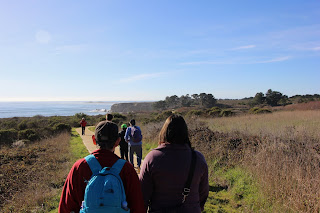
First you take a lovely drive down Route 1 on the California coast for about an hour; the boys were entranced. (And Aaron could actually enjoy it, because of his miracle wristbands.) Then you take a wonderful long walk from the parking area down to the beach - a good 30-45 minute stroll. There are pelicans on the way.


And then there you are, at the beach level, basically eye to eye with however many seals you feel like counting. In December there are newborn pups, males fighting for the rights to the harems, and just generally a whole lot of action. It's amazing.


They even come back into the sand dunes when the beach gets too crowded. Tourists like us, walking through the sand dunes, are escorted by a docent, in case we need to detour around a giant seal blocking the trail. They're not aggressive with humans; they just don't care about people at all, which means that if you're in between them and some place they want to go, they'll just mow you down. So we give them a wide berth. The big ones are 5000 lbs, the size of an SUV, so this really doesn't take much convincing.


The highlight of the visit was an epic battle between two males, which went on for upwards of half an hour - very rare. Usually they just face off and somebody loses, but these two were very evenly matched. Look how they're tearing each other up! What a spectacle.


Then a beautiful walk back to the parking lot, and home again. We'd love to do this again next year.


Muir Woods

While we were in SF, we were excited to visit Muir Woods. I can't remember if I ever went there growing up, but redwoods, right? We tried to go last year and literally could not park; this year, there is a brand new shuttle system with reservations, which made the whole thing much easier. And I love a walk in the woods.

It was beautiful, all right, but when we had been there for a few minutes I realized: It's very much like Seattle. We could literally walk to the city park near our house and go for quite a similar walk. Okay, our big trees are a different species than California's, but the overall effect is very much the same. Even the cold and damp is reproduced pretty faithfully, down there in the canyon next to Mt. Tam.

Still, we enjoyed ourselves, and learned that the United Nations had met there in 1945 (!).


The other thing that is tough about Muir Woods is the long, very windy drive down into the valley. Oof. Aaron is especially susceptible to motion sickness and that is really no fun. Fortunately, Jes had the bright idea of trying out motion sickness wristbands. Wow, do those ever work! We do a lot of driving on these SF trips, and Aaron was dramatically more comfortable with these on board.