Aaron is in a “Rockets and astronauts” camp this week. Little did I know it was physics camp!
Aaron: Mommy today I learned about kinetic force and potential force.
Rachel: Really! Please tell me all about it.
Aaron: Kinetic force is the force that something has because it is moving. Potential force is the force that it has when it is not moving yet, but of course it could move, so it has the potential to be moving. And also when it is moving and it has kinetic energy, it has the potential to be not moving. So they go together.
Rachel: I totally love to hear about this. One of the things that I study at my work is how to teach people about exactly these kinds of things, including kids, so I love to hear from you how you are learning about it.
Aaron: Another thing I learned today is that when an airplane flies, there are four forces that keep it flying.
Rachel: Oh really? Tell me about that.
Aaron: One of them is lift which keeps it up. And one of them is gravity which of course pulls it down. And Mommy did you know that when an airplane is just staying at one level it has both of those? Let me show you with my lunchbox. One pushes from one side and the other pushes from the other side! [demonstrates by pushing his hands on the left and right sides of his lunchbox.] And so even though it has two pushes, those pushes push one way and the other way at the same time, so they keep it where it is.
Rachel: How about that!
Aaron: And another thing I learned today is that our car is not red.
Rachel: Really? I would have called it red!
Aaron: No mommy. Actually somehow they made it so that it is every color except red, and the red, it bounces off the car. So the red, is not the color that the car is. It is every other color, but you see the red.
In case you are wondering I have no interest at all in correcting any parts of this that are not the same as the scientific canon. I am too interested in hearing what he makes of it, and if I jumped in with a lecture I would risk curtailing his expression. I hear him having taken in that there are two complementary kinds of "strength"-type quantities, one associated with motion and one associated with not-motion. I hear him expressing that stability can be associated with balanced pushes. And I hear him saying something about how the color a thing "is" is the colors that it "keeps" (as opposed to those that it "rejects"), which totally makes sense in a way. It reminds me of some light bulbs I recently bought that claimed to "make colors appear as they really are." Quite a puzzle really.
Tuesday, June 30, 2015


Tuesday, June 2, 2015
Wedding
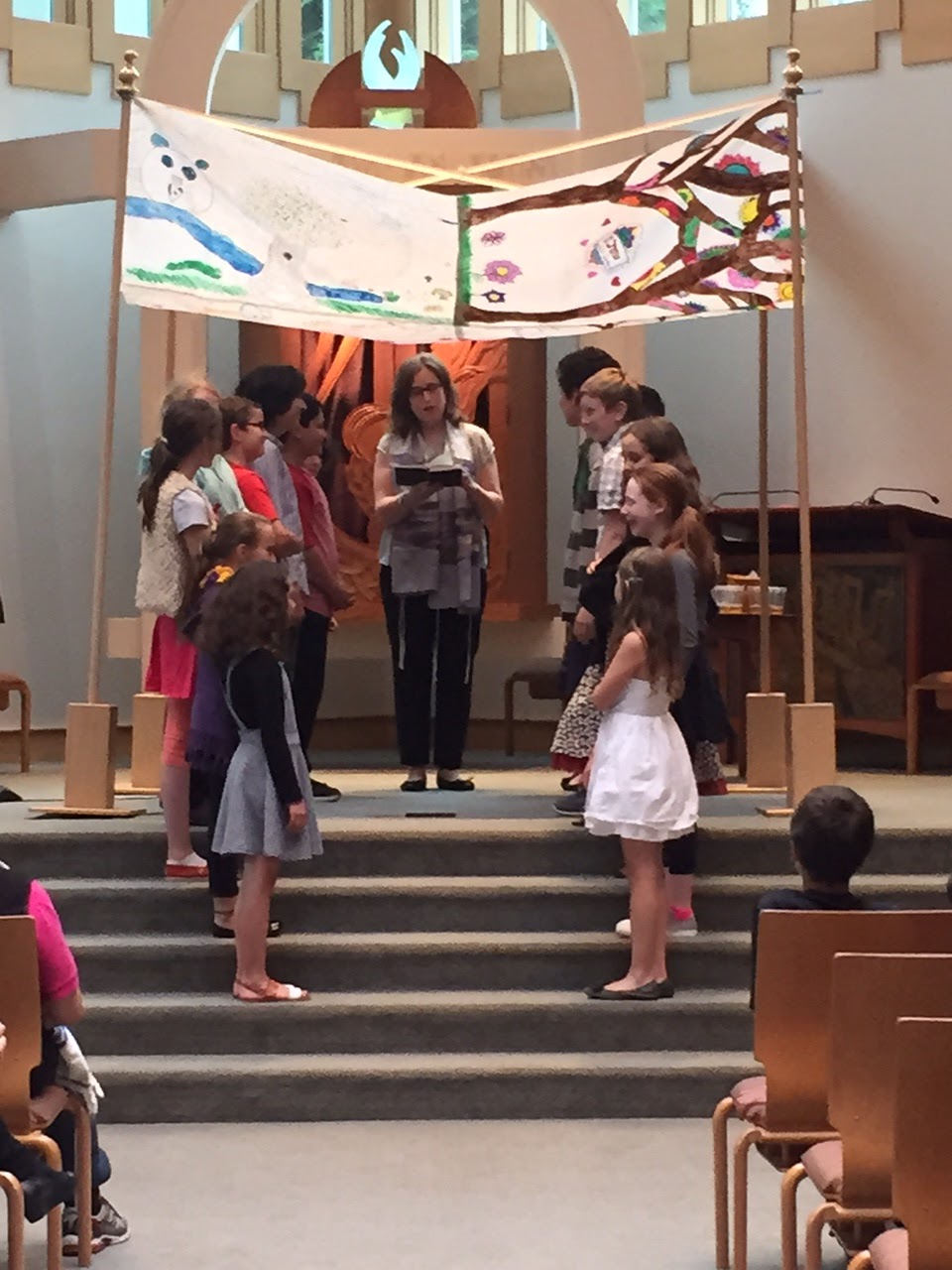
Jordan participated in a mock wedding at religious school this evening. There were eight couples, with no regulations about gender; Jordan's class is all boys, so he married his buddy Moses. Here is Rabbi Allison performing the ceremony, under a chuppah made by the students.

The whole thing was very educational. I had not known that a rabbi is not necessary for a wedding (according to Jewish law; civil law requires the presence of either a religious or a civil official). Evidently the essentials are a ketubah (wedding contract), two qualified witnesses, and the proper blessings and sanctifications. The kids performed many of these - they circled each other, they said the blessing over wine, a sample ketubah was read aloud, they exchanged rings (edible), and they smashed a plastic cup. Rabbi Allison made sure that they left certain key words out of the blessing that officially causes you to be married. Here they are sporting their ring pops.

Afterwards there was a hilarious reception with wedding cake and chair dances. The students had all made ketubot, which were hung in the windows. I love this one, stating their commitment "not to be a buzzkill":


Here is Jordan's - it's hard to read with the light shining through it so I reproduced the text below.

The whole thing was very educational. I had not known that a rabbi is not necessary for a wedding (according to Jewish law; civil law requires the presence of either a religious or a civil official). Evidently the essentials are a ketubah (wedding contract), two qualified witnesses, and the proper blessings and sanctifications. The kids performed many of these - they circled each other, they said the blessing over wine, a sample ketubah was read aloud, they exchanged rings (edible), and they smashed a plastic cup. Rabbi Allison made sure that they left certain key words out of the blessing that officially causes you to be married. Here they are sporting their ring pops.

Afterwards there was a hilarious reception with wedding cake and chair dances. The students had all made ketubot, which were hung in the windows. I love this one, stating their commitment "not to be a buzzkill":

Some were quite beautiful:

Here is Jordan's - it's hard to read with the light shining through it so I reproduced the text below.

I agree, as bonds of this wedding
create, to be a faithful, good husband.
As husband of this marriage I also agree
to keep peace and make a family tree
of amazing Jews. I promise to have the
power to support this family and dedicate
my life to the rest of my relatives, my kids,
and my bond. This marriage means
that I will make this experience worthy
of its work to all of our family
NOW + FOREVER.
Mazel tov!
Sunday, May 31, 2015
D&D
Jordan has become a Dungeons and Dragons player. This started with a day off school on which he
 and his friends were all at one house (a regular and excellent arrangement), and the parent in charge took the day to teach them all to play. The current phase has been fueled by an afterschool D&D club full of good friends and run by another parent. For those of you who don't know, D&D is a tabletop roleplaying game in which each player is a character in a traveling company, sort of like the Fellowship of the Ring. The leader, who is called the dungeonmaster, creates an imaginary setting (usually medieval), and the characters have adventures in that setting. The action unfolds through collaborative storytelling led by the dungeonmaster, but it is not a free-for-all: the dilemmas, battles, discoveries, and encounters that take place are regulated partly by each character's abilities (Strength, Constitution, Dexterity, Intelligence, Wisdom, and Charisma) and partly by rolls of special many-sided dice, as well as the internal logic of the story. Characters generally get stronger with experience, and players who play for a long time may develop their favorite character for years. Jordan's character is a human fighter named Sinister, nicknamed RangeMaster, who holds a great-sword and an extremely accurate longbow. His character's brother is the character played by his friend Lior, also a marksman, with special training that has earned him infinite arrows.
Jordan looooves this. It comes so naturally to him and his friends, who have been doing spontaneous collaborative storytelling for years -- put them together and they will walk around the yard devising adventures and negotiating outcomes for hours on end. D&D extends this basic activity into a game that is has enough structure to generate exciting situations, and that can have continuity and development from one session to the next. As a parent I am delighted: D&D is highly creative, highly social, low-tech, and minimally commercial. (Also see positive qualities of nerds.)
The quality of a D&D experience is hugely influenced by the talent of the dungeonmaster running it, and Jordan's DM, Ben, is a treasure. From what I hear, his storytelling may as well be performance art, and he is passionate about nurturing the creative spark he sees in the kids. He is also a fiction writer, and passionate about getting the kids to write their stories. Evidently he knows what he's doing, because he is extremely inspiring to Jordan. Our (former??) reluctant writer now assigns himself D&D story-writing homework and asks to write for fun. He sits himself down at the family laptop and puts on the sound-blocking headphones so that he can concentrate. One day a couple weeks ago he had finished all his schoolwork at school and thus spent every spare minute after dinner writing his story. When offered dessert, he said, "No thanks. This is my ice cream." Are you kidding? I almost burst into tears. He did even more writing before breakfast the next day.
Something else to love about D&D is that the gender business has hugely improved in the last few decades. One day I was grousing about how in most games (especially video games), there aren't any female characters at all, and if there are, they are wearing underwear. Even if they are in a battle. Why would anyone fight in their underwear? It doesn't make any sense. I showed Jordan the Wonder Woman comic posted here and he thought it was hilarious.

Then he got out his D&D Player's Handbook (6th Edition) and demonstrated to me that (1) there is an equal share of female characters represented in the illustrations, (2) they are supercool characters with incredible powers, and (3) they are appropriately dressed for what they are doing. This is apparently something the D&D designers have been working on, which only makes sense for expanding their market. I have to say I am impressed. Here is what the Player's Handbook says about selecting your character's sex:

The quality of a D&D experience is hugely influenced by the talent of the dungeonmaster running it, and Jordan's DM, Ben, is a treasure. From what I hear, his storytelling may as well be performance art, and he is passionate about nurturing the creative spark he sees in the kids. He is also a fiction writer, and passionate about getting the kids to write their stories. Evidently he knows what he's doing, because he is extremely inspiring to Jordan. Our (former??) reluctant writer now assigns himself D&D story-writing homework and asks to write for fun. He sits himself down at the family laptop and puts on the sound-blocking headphones so that he can concentrate. One day a couple weeks ago he had finished all his schoolwork at school and thus spent every spare minute after dinner writing his story. When offered dessert, he said, "No thanks. This is my ice cream." Are you kidding? I almost burst into tears. He did even more writing before breakfast the next day.

Then he got out his D&D Player's Handbook (6th Edition) and demonstrated to me that (1) there is an equal share of female characters represented in the illustrations, (2) they are supercool characters with incredible powers, and (3) they are appropriately dressed for what they are doing. This is apparently something the D&D designers have been working on, which only makes sense for expanding their market. I have to say I am impressed. Here is what the Player's Handbook says about selecting your character's sex:
You can play a male or female character without gaining any special benefits or hindrances.That itself is huge. But it goes on:
Think about how your character does or does not conform to the broader culture's expectations of sex, gender, and sexual behavior. For example, a male drow cleric defies the traditional gender divisions of drow society, which could be a reason for your character to leave that society and come to the surface.
You don't need to be confined to binary notions of sex and gender. The elf god Corellon Larethian is often seen as androgynous or hermaphroditic, for example, and some elves in the multiverse are made in Corellon's image. You could also play a female character who presents herself as a man, a man who feels trapped in a female body, or a bearded female dwarf who hates being mistaken for a male. Likewise, your character's sexual orientation is for you to decide.WHOA. I have to say, I could have used a little more of that gender openness the one time that I tried to play D&D. I had friends in high school who played, and I wanted to try it; the DM sort of tossed me a character sheet, but didn't give me any guidance that I remember. I felt really lost but gave it a go anyway, making up a name and I forget what else for my character. I think the name was Rayna. He took one look and said, "Character with a name like that probably isn't going to make it." I had no idea what was wrong with the name, but I got the message: This game is not for you. Now I think what was wrong with the name is that it was feminine. I bet if I had named my character GrrrThor I would have been included. Fast forward thirty years, and Jordan's D&D club has kickass girls in it; I don't know their character's names, but I know that in the last session one of them blew out a zombie with her flame pack, and in an earlier adventure, another girl solved a puzzle by surfing across a lava lake on her shield. Some things are better than they used to be.
Friday, May 22, 2015
Poetry slam
Aaron's class concluded their poetry unit this week with a Poetry Slam. The kids read original poems and recited memorized works by favorite poets. They all wore black, with berets if they had them, and performed with a microphone. The classroom was transformed into a beatnik cafe: dim lighting, white tablecloths, electric candles, flowers in little jars. Parents were invited to snap their fingers for applause, rather than clapping. It was absolutely fantastic. Here are Aaron's original poems:
Fern
Your Green
Quills
Protect you
From the army of
Weeds
Thank you
For using
Your medicine
Sword Fern
(Aaron explained that this has to do with using sword fern to treat poison ivy, which is something he apparently learned at camp.)
Tiger
You brazen thing!
You meany!
You fierce cat!
You trick the animals
and you steal Indians' food!
"Brazen!" I love it. His readings were excellent. He is wonderfully expressive and his delivery is really very good. While he was practicing his poems at home, he and I watched a video of Taylor Mali, who includes movement in his performance of his poems; I think this helped inspire Aaron to add meaningful movement (instead moving in just an antsy way). Please check him out. The lighting is terrible, as in all beatnik cafes, but if you stick with it you can see his beret when he models the endless rows of gumdrops.
Thursday, April 30, 2015
Walnut Canyon
Just twenty minutes outside of Flagstaff is Walnut Canyon, a totally cool National Monument full of cliff dwellings that you can actually walk into. You take a terrific hike down (and eventually up) long staircases into the canyon, then tour around an interesting "island" in the middle of the canyon, poking into the cliff dwellings at will.


For those not interested in the 240 stairs down and up, or whatever it was, there is a rim trail. Grandpa is right in the center of this photo.

The canyon has lots of interesting plant life. This one is a euphorbia.

Alligator juniper.

Claret cup cactus.

Painted Desert and Petrified Forest
On the way from Canyon de Chelly back to Flagstaff, we drove through the Painted Desert, which is just bizarre, the hills vividly striped in precise horizontal bands.


(That's one of our rental cars; we needed two for all of our family and luggage.)


On the same road, we were suitably amazed by the Petrified Forest, where the petrified logs really look exactly like fallen fresh trees but are made of brilliant agate and amethyst. Even the wood chips look exactly like wood chips but are gems. We were all stunned.


Jordan demonstrated that even though what he's holding looks like a soft wood chip, it's as strong and hard as a rock (because it is a rock).

I wonder how many generations of tourists, though, are lulled by the name "Petrified Forest" into imagining the trees are still standing. Would it not be incredible, to walk through a forest turned to stone? This is not a forest. But it's still a very imaginative place.

Canyon de Chelly
Our spring break in Northern Arizona also included a day at Canyon de Chelly. I learned why it is pronounced “shay”: the Navajo word is Tseyi, meaning “within the rocks,” and when the Spanish came along they transliterated that to Chelly and added “Canyon de,” which was redundant. An amusing representation of the cultural mixing and misinterpreting of colonialism. We took a driving tour into the canyon. This canyon is less spectacular and more intimate than Monument Valley, more about the human history. The big attraction for people like us is the cliff dwellings and petroglyphs and pictographs, which are amazing. But also it was interesting to learn that plenty of families still live in Tseyi, especially in the summer; they farm, and graze horses and sheep, and overall have a life not entirely unlike the people who built those cave dwellings.
Here we are outside our tour vehicle with our guide, Perry, on the right. Much more comfortable than the open-air truck in Monument Valley, but much less visibility.

The canyon is pretty spectacular when you get all the way into it. Car on the lower right for scale.

The drive is all through the "wash" of the river that flows in the canyon, mostly just a few inches deep.


There are cliff dwellings everywhere in the canyon; here are some we got relatively close to. Note both levels.

It's interesting to think about; why build there? There is good shelter and good isolation from invaders (human or animal), but man, the work of just getting in and out of your little town all the time, and carrying water? seems like a lot. Another possibility is that there were dwellings all over the canyon, and the cliff dwellings are the only ones left (because they are protected from the elements, and hard to get to).

Pictographs and petroglyphs are a major attraction. I learned that pictographs are drawings on rock, added with paint or stain; petroglyphs are drawings pecked into the rock. As for what they mean, very hard to say. Some of them seem like they might be pieces of a written language like Egyptian hieroglyphs, some seem to show scenes of events like hunting parties, some seem like art, some seem like graffiti. It is undeniably something, though, to be looking at marks made by ancient people.
Petroglyph from Canyon de Chelly:

Petroglyph from Monument Valley:

Back to Canyon de Chelly for pictographs: these are antelopes.

You may have to enlarge this one to see the pictographs: imagine someone climbing up to the base of that cliff face to do these. wow.

Subscribe to:
Posts (Atom)